A Digitalhound working proposition for CMOs, marketing leaders and the SEO community
What is Semantic Seeding?
Semantic Seeding is the deliberate publication and distribution of consistent, useful and verifiable information across the digital sources that search engines and AI systems may retrieve, compare and cite.
The internal workings of those systems remain proprietary. This article therefore does not claim to describe one universal algorithm. It advances a testable proposition: repeated, corroborated semantic associations can create a cumulative visibility advantage across search and AI discovery.
Table of Contents

SEO Sculpting Did Not Disappear. Its Canvas Expanded.
For more than two decades, SEO practitioners have shaped how search engines interpret websites. We refined information architecture, internal links, headings, anchor text, structured data and external authority signals.
That work was often described as SEO sculpting: arranging the available signals so that search systems could understand importance, relevance and relationships.
The emergence of generative search does not make those foundations obsolete. Google itself says that established SEO best practices remain relevant to its AI features. Organic rankings, crawlability, accessibility and useful content still matter. But the surface being optimised is becoming wider.
A brand can now be encountered through a conventional result, an AI Overview, Microsoft Copilot, ChatGPT search, Perplexity, Gemini, an industry database, a product feed, a public dataset, a review platform or a third-party discussion.
The question is no longer only whether one page ranks. It is whether the wider evidence environment consistently connects the brand with the problems it solves, the expertise it possesses and the proof supporting those claims.
Our contention is that Semantic Seeding is what SEO sculpting begins to look like when the object being shaped is not merely a page or link graph, but a distributed body of retrievable evidence.
The Digitalhound Semantic Seeding Framework
Digitalhound definition
Semantic Seeding is the disciplined process of making a brand’s genuine expertise, evidence and entity relationships clear and consistent across appropriate owned, earned and third-party sources, so that both people and machines have a better chance of finding, corroborating and citing them.
This is not an instruction to repeat identical slogans across the web. Repetition without substance is noise. Nor is it permission to manufacture reviews, infiltrate forums or create apparently independent validation. Those activities would damage trust and could cross into spam or deception.
The seed must be something worth propagating: original research, an expert interpretation, a transparent methodology, an accurate specification, a genuinely useful tool, a documented outcome or first-hand experience. Distribution then makes that evidence easier to discover in the places where relevant decisions and discussions occur.
A simple example might be a specialist software company seeking association with zero-downtime legacy migration. Its website can state that expertise, but the association becomes more credible when supported by public technical documentation, tested code examples, customer evidence, independent implementation discussions and consistent product information. The objective is not to make a claim louder. It is to make the claim clearer, more useful and more corroborated.
The Vector Cloud: A Useful Metaphor, Not a Map We Can See
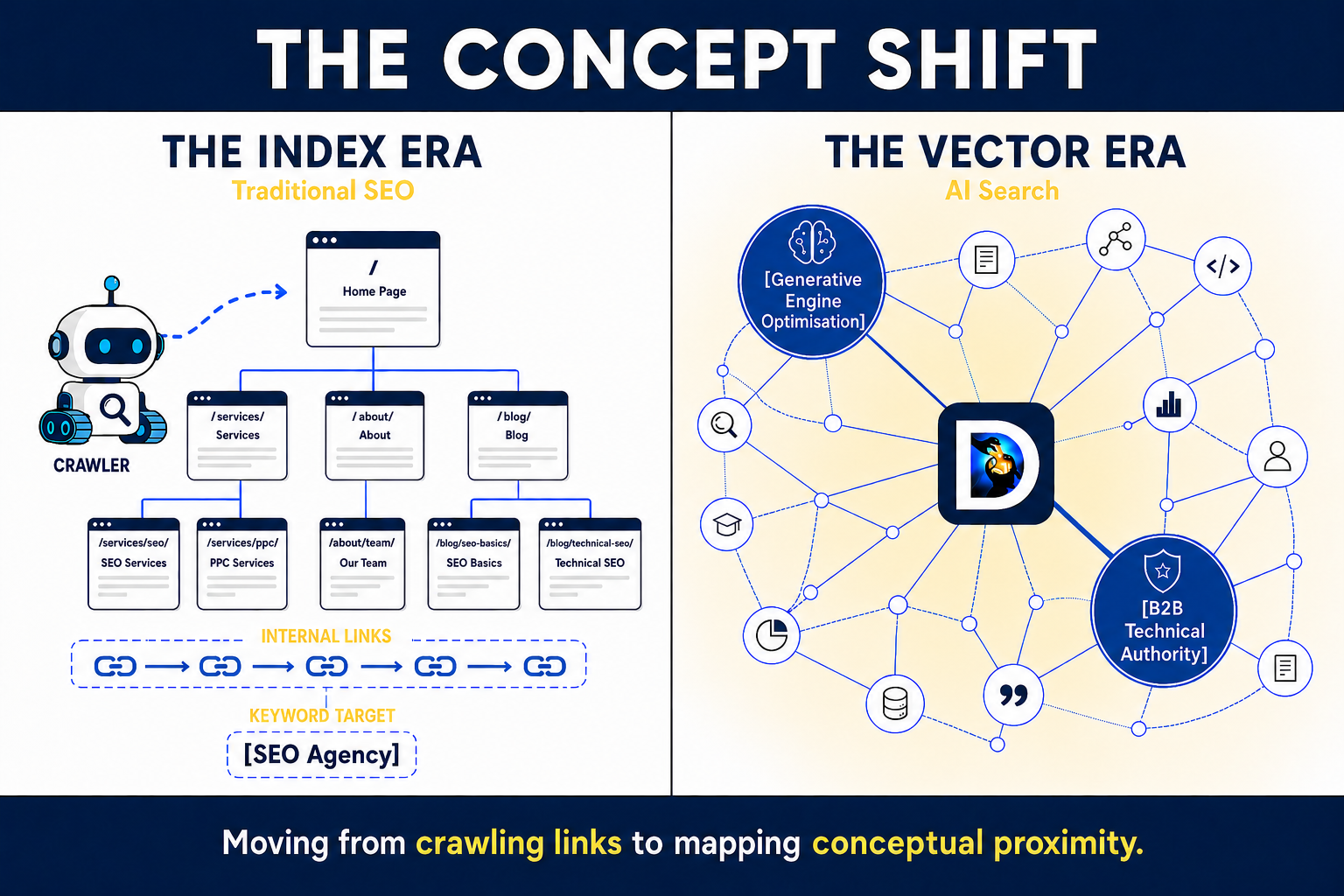
Modern retrieval systems often use numerical representations of language, commonly called embeddings, to identify conceptual similarity. In some implementations, cosine similarity measures how closely two vectors point in the same direction. This helps explain how a system can retrieve conceptually related information even where the wording is not identical.
That does not mean there is one universal vector cloud shared by Google, Microsoft, OpenAI, Anthropic and every other platform. Each system can use different indexes, models, ranking layers, freshness signals, safety controls and retrieval methods. Publishers cannot inspect those proprietary environments or assign themselves a guaranteed mathematical position within them.
We therefore use the vector cloud as a metaphor for the changing information environment. If a brand repeatedly appears near accurate descriptions of a problem, solution or expertise across credible sources, it is reasonable to test whether that consistency improves retrieval and citation. It is not reasonable to promise that an external marketer can directly manipulate model weights or force a recommendation.

The Cumulative Effect: How Evidence May Compound
Semantic Seeding is not conceived as a one-page intervention. Its potential lies in accumulation. One useful resource may be cited once. A connected body of original resources, corroborating references and consistent facts creates more routes through which the brand can be discovered and evaluated.
1. The Real-Time Retrieval Layer
When an AI system performs a live search or retrieval step, it may assemble information from several sources before producing an answer. The number and selection method vary by platform and query. A brand improves its opportunity to be included when relevant material is crawlable, explicit, current, well structured and supported by evidence.
At this layer, cumulative advantage comes from coverage and clarity. Different resources may satisfy different aspects of a complex request: a definition, a methodology, a comparison, a regional detail, a specification or a real-world outcome.
Together they give the retrieval system more useful entry points than a single polished sales page can provide.
2. The Corroboration Layer
First-party claims are necessary, but independent corroboration can make them more credible. Relevant coverage, honest customer experience, professional discussion, public records and cited data can confirm that a brand’s own description is not isolated.
This is where an Audience Moat matters. Real people interpret, question, apply and share the work. Their participation cannot be manufactured without undermining the very trust the strategy is intended to build.
3. The Longer-Term Information Environment
Public information can also influence future indexes, datasets, knowledge resources and model versions, but this is the most speculative layer. Model developers use different data sources and development cycles, and publishers cannot know when or whether a particular document contributes to a future system.
The prudent strategy is therefore to publish information because it is useful, accurate and worth preserving. Any longer-term machine memory should be treated as a possible consequence, not a guaranteed result.
Why Corporate Polish Needs Independent Evidence
A beautifully written service page can explain a proposition, but it is still a first-party claim. Search and AI systems have access to a much wider information environment: journalism, reviews, public records, academic work, technical repositories, product feeds, community discussions and primary datasets.
The provocative version of the argument is that polished corporate copy may become less influential when it is not supported elsewhere. The more useful version is that owned content and independent evidence perform different jobs. The website defines the proposition; external evidence helps corroborate it.
This does not mean unstructured chaos automatically wins. Unstructured sources contain error, bias, manipulation and outdated information. The opportunity lies in contributing genuine expertise where it belongs and ensuring that important facts remain consistent across the sources a buyer or retrieval system is likely to encounter.
The Connecting Digitalhound Framework
Semantic Seeding is not intended to stand apart from Digitalhound’s other thinking. It connects the creation, distribution, human validation and measurement of authority.
1. The Human Moat creates the evidence
Original data, real experience, verifiable proof and expert interpretation give the brand something AI cannot independently originate. Without that substance, there is nothing meaningful to seed.
2. Semantic Seeding distributes and clarifies it
The evidence is translated into useful forms and made discoverable across relevant owned and earned surfaces. Entity relationships, terminology and facts remain consistent without becoming mechanical duplication.
3. The Audience Moat tests and carries it
Customers, practitioners, journalists, partners and communities question, reference and apply the work. Their independent engagement creates human corroboration and further evidence.
4. Citation Share measures whether machines select it
Citation Share asks not merely where a brand ranks, but how often it is cited relative to an identified set of competitors for the questions it should be helping to answer. Citation volume is useful; genuine share requires the comparator set.
THE CONNECTED SEQUENCE: Human Moat creates the evidence. Semantic Seeding makes it discoverable. Audience Moat supplies human corroboration. Citation Share measures whether search and AI systems select it.
6 CMO Thought Experiments: From Theory to Action
The following scenarios are deliberately illustrative. They are not reported historical case studies or guaranteed outcomes. Their purpose is to show how a CMO might apply and test the Semantic Seeding proposition in different sectors.
1. Legal Services: Commercial Law and Litigation
- The discovery question: Which UK law firm has demonstrable experience in a particular cross-border regulatory or commercial dispute?
- The evidence opportunity: Publish detailed commentary on public judgments, procedural explainers, decision frameworks and anonymised case analysis where client consent, confidentiality and professional obligations permit.
- Appropriate distribution: Contribute genuine expertise to legal publications, professional associations, seminars, academic collaborations and relevant legal technology repositories. Link every interpretation to primary legislation, judgments or regulatory guidance.
- Associations to reinforce: Specific practice areas, jurisdictions, regulated sectors, procedural expertise and documented outcomes, rather than generic claims such as award-winning or full service.
- What to measure: Inclusion and citation across a controlled set of legal questions, cited-page accuracy, relevant search-query growth and qualified enquiries. Never infer legal authority solely from an AI recommendation.
2. Travel and Tourism: Luxury and Adventure Operators
- The discovery question: Can an AI assistant build a reliable, accessible or sustainable itinerary that reflects real local conditions rather than repeating a generic destination list?
- The evidence opportunity: Publish verified journey times, seasonal constraints, accessibility details, route warnings, local regulations, supplier information and first-hand destination knowledge. Where useful, make selected route or itinerary data available in practical formats such as GPX or CSV.
- Appropriate distribution: Earn references through destination organisations, specialist travel publishers and useful mapping or planning communities. Participate transparently rather than planting promotional posts in forums or subreddits.
- Associations to reinforce: Verified local knowledge, realistic itinerary planning, traveller reassurance, accessibility, sustainability and specialist regional experience.
- What to measure: Citation frequency, itinerary-query coverage, cited destination pages, organic visibility, referral traffic and enquiries or bookings influenced by informational content.
3. Hospitality: Boutique Hotels and Premium Venues
- The discovery question: Which venue can satisfy a detailed brief involving capacity, connectivity, accessibility, sustainability and travel time?
- The evidence opportunity: Publish exact capacity, room dimensions, internet performance, AV specifications, accessibility information, menu options, environmental credentials and transport details in accessible text.
- Appropriate distribution: Keep specifications consistent across the website, Google Business Profile, booking platforms, event directories and relevant public records. Encourage honest descriptive reviews without prescribing what guests should say.
- Associations to reinforce: The particular event types, facilities and operational requirements the venue can genuinely satisfy.
- What to measure: Accuracy of AI answers, inclusion in detailed venue prompts, direct enquiries and the consistency of facility information across platforms.
4. B2B Software and SaaS
- The discovery question: Which product can solve a specific integration, security or workflow problem within an existing technology stack?
- The evidence opportunity: Publish working documentation, integration guides, API schemas, tested examples, release notes, benchmark methodology and honest limitations.
- Appropriate distribution: Use public repositories and developer communities where the material is genuinely useful. Support technical discussions rather than manufacturing them, and keep examples current through automated testing where possible.
- Associations to reinforce: Named integrations, measurable performance characteristics, compliance status and precise use cases.
- What to measure: Citation in technical answers, documentation referral traffic, trial starts, integration-related conversions and the accuracy with which AI systems describe product capabilities.
5. Professional and Financial Services
- The discovery question: Which adviser has demonstrable expertise in a complex, highly regulated situation?
- The evidence opportunity: Create properly sourced white papers, transparent calculators, original indices, decision frameworks and expert commentary tied to current legislation and primary regulatory material.
- Appropriate distribution: Seek earned publication through professional bodies, reputable financial media, academic or industry repositories and specialist events. Apply compliance review before publication.
- Associations to reinforce: The precise jurisdiction, client type, transaction or regulatory problem the firm is qualified to address.
- What to measure: Citation accuracy, high-intent question coverage, downloads, consultation requests and assisted conversion, while treating AI outputs as discovery rather than regulated advice.
6. Consumer Brands and E-commerce
- The discovery question: Which product best satisfies a combination of fit, material, durability, provenance, price and ethical preferences?
- The evidence opportunity: Publish complete specifications, variant data, material provenance, independent test results, care information, fit guidance, recognised identifiers and verified customer experience.
- Appropriate distribution: Maintain consistent product data across the website, merchant feeds, marketplaces and review platforms. Support genuine enthusiast communities with useful expertise rather than promotional seeding.
- Associations to reinforce: Specific use cases and verifiable attributes, not vague lifestyle adjectives.
- What to measure: Product inclusion in comparative prompts, accuracy of specifications, cited sources, AI referral traffic and conversion by product attribute.

Live Commercial Evidence: GetCarHire.com
GetCarHire.com provides a measured result against which the wider proposition can be considered. It is not presented as proof that Digitalhound altered a proprietary vector space or that one technical intervention caused every outcome.
When Digitalhound was engaged to rebuild the established travel website, its existing Xara platform constrained further development and the site had effectively zero measurable Bing AI citation visibility. The programme migrated the website to WordPress, audited and pruned legacy content, rebuilt the information architecture and developed interconnected destination ecosystems around real traveller needs.
Instead of treating every page as an isolated keyword target, commercial destination hubs were supported by useful material covering journeys, driving conditions, seasonal considerations, local experiences and practical uncertainty. The work combined technical accessibility, structured presentation, internal relationships, original assets and human-focused usefulness.
VERIFIED MEASUREMENT
From effectively zero recorded Bing AI citations at baseline, GetCarHire.com reached 20.2K Total Citations across Microsoft Copilot and supported partner experiences within the selected three-month reporting window.
Bing reported an average of five unique cited pages per day over that window. Google Search Console also recorded more than 1,000 distinct search queries generating impressions during the reported period. No paid media campaign produced those visibility figures.
Microsoft states that Total Citations measure appearances as sources in AI-generated answers. The metric does not indicate ranking, authority, placement or the role of a page within an individual answer.
The result should therefore be described as a substantial citation footprint, not dominant Citation Share unless a defined competitor comparison has also been completed.
The result is consistent with the Semantic Seeding hypothesis: a larger, clearer and more useful body of interconnected destination evidence created many more opportunities for retrieval and citation. It does not prove precisely how Microsoft or Google weighted each intervention.
The honest conclusion is both strong and limited: the website became a materially more useful source, and its measurable search and AI visibility changed rapidly alongside that work.
Technical Integrity: Making Evidence Easier to Use
Semantic Seeding cannot compensate for inaccessible pages, contradictory facts or weak evidence. The technical layer should reduce ambiguity and preserve provenance without pretending that any markup guarantees citation.
Crawlability and textual accessibility
Important information should be available in crawlable text, supported by logical internal links, accurate status codes, canonical signals and current sitemaps. Interactive experiences should not hide the facts needed to understand a product, service or destination.
Structured data and semantic relationships
Schema.org markup can provide explicit clues about people, organisations, products, services, articles, reviews and other entities. The markup must match what users can see on the page. Subject-predicate-object thinking can also help teams define relationships consistently, but repeating a semantic triple does not guarantee that an external system will construct or accept that relationship.
Provenance and verification
Original research should explain its method, period, sample and limitations. Claims should link to primary sources where possible. Datasets should include version dates and field definitions. Signed releases or cryptographic verification can be valuable for software and downloadable data, but should be treated as provenance controls rather than assumed AI authority signals.
The optional role of llms.txt
The llms.txt convention proposes a markdown-formatted directory that may help supporting agents locate selected website resources. It remains an emerging and unevenly adopted convention. Google Search states that it does not use llms.txt and that the file neither helps nor harms visibility or rankings in Google Search.
A business may maintain an llms.txt file as an experiment for other tools or agents, especially where it publishes extensive technical documentation. It should not be described as critical infrastructure, an official search standard or a substitute for accessible HTML, useful content and conventional technical SEO.
Ethical distribution
Publication and participation must respect the purpose and rules of each platform. Genuine expert contributions, voluntary reviews, earned coverage, open data and useful documentation are legitimate. Covert promotion, manufactured consensus and duplicated claims disguised as independent discussion are not Semantic Seeding as Digitalhound defines it.

How Should a CMO Measure the Cumulative Effect of Semantic Seeding?
No single metric captures this strategy. The measurement framework should combine machine visibility, search performance, evidence quality and commercial outcomes.
- Total citation activity: Track citations, cited URLs, grounding queries and change over time using platform-provided reporting where available.
- Citation Share: Compare citation inclusion against a fixed, declared competitor group and controlled question set.
- Prompt inclusion and accuracy: Repeat the same representative questions by model, date, location and account state. Record whether the brand appears, how it is described and which sources are cited.
- Entity consistency: Audit whether critical facts, names, services, locations, specifications and credentials remain aligned across owned and independent sources.
- Search and referral performance: Measure relevant query growth, organic impressions, clicks, AI referral traffic and the pages that attract high-intent visitors.
- Business impact: Connect visibility to qualified enquiries, sales, bookings, pipeline contribution and assisted conversion wherever the data permits.
Embedding-based proximity scores can be used experimentally inside a controlled research environment, but scores are model-specific and should not be treated as universal ranking thresholds. A movement from 0.70 to 0.85 in one open-source model does not prove equivalent movement inside a proprietary search system.
An Actionable Semantic Seeding Roadmap
- Establish the baseline. Define the commercial questions the brand should credibly answer. Record current rankings, citations, cited pages, AI descriptions, referral traffic and competitor inclusion before changing the evidence environment.
- Map the associations. Identify the entities, services, problems, attributes and proof that must be connected. Use plain language and subject-predicate-object thinking where it helps remove ambiguity.
- Create the Human Moat assets. Produce original data, expert analysis, useful tools, tested documentation, real experience and verifiable case evidence. Do not distribute claims that have not first earned the right to exist.
- Publish and distribute appropriately. Make the evidence accessible on owned properties, then pursue relevant earned coverage, professional contribution, partnerships, repositories and community participation. Adapt the form to the platform rather than duplicating promotional copy.
- Validate continuously. Check factual consistency, dates, sources, schemas, product feeds, public profiles and third-party descriptions. Correct contradictions before they compound.
- Measure the cumulative effect. Repeat the controlled audit at agreed intervals. Separate observable results from interpretation and retain the commercial outcome as the ultimate test.
A Challenge to the SEO Community
Is Semantic Seeding genuinely new, or is it the convergence of technical SEO, digital PR, entity optimisation, content strategy, product data and reputation management under a new name?
That is a fair challenge. Many of its component practices existed long before generative AI. SEO has never been limited to title tags, and strong brands have always benefited from consistent facts, useful evidence and independent recognition.
The change may lie less in the individual tactics than in the object being shaped. Traditional SEO sculpting concentrated heavily on how a search engine interpreted and ranked web pages.
Semantic Seeding asks how a distributed answer system encounters, corroborates and selects evidence about a brand across multiple sources and formats.
That proposition raises questions worth testing:
- Can a brand deliberately improve retrieval consistency without crossing into manipulation? If so, which forms of evidence have the greatest effect?
- Does independent corroboration matter more than first-party information? Or does the balance vary by sector, question and platform?
- How quickly can a dormant or poorly understood entity become visible? What part is played by technical accessibility, content depth, external evidence and freshness?
- Can Citation Share become a dependable management metric? What competitor set and prompt methodology are needed to make it meaningful?
- Where is the ethical boundary? At what point does helpful distribution become manufactured consensus or data pollution?
Digitalhound does not claim that every answer is already known. That is precisely why the subject deserves investigation rather than another checklist of supposed ranking factors.
The Road Ahead
Websites increasingly serve a dual purpose. They must remain useful, persuasive and intuitive for people while presenting accurate, accessible and well-connected information to machines.
The brands most likely to benefit will not be those that simply repeat themselves most often. They will be those with something original to contribute, the discipline to publish it clearly, an audience willing to test and carry it, and the measurement needed to learn whether machines are selecting it.
Semantic Seeding may not replace SEO. It may be what SEO sculpting becomes when the target is no longer one index or one ranked page, but a distributed ecosystem of answers.
That is the proposition. The next stage is to test it.


Digitalhound's work spans technical SEO, AI-assisted content strategy, conversion optimisation and brand authority. The agency's content has achieved first page Google rankings against globally recognised publishers including Search Engine Land, TripAdvisor and Saga Holidays.
Darryl is a sought-after speaker at digital marketing conferences and has worked with clients ranging from independent law firms to FTSE-listed businesses. He writes on the intersection of AI, search strategy and commercial communication.
Digitalhound | 207 Regent Street, London W1B 3HH | digitalhound.co.uk | content@digitalhound.co.uk | 020 7873 2476