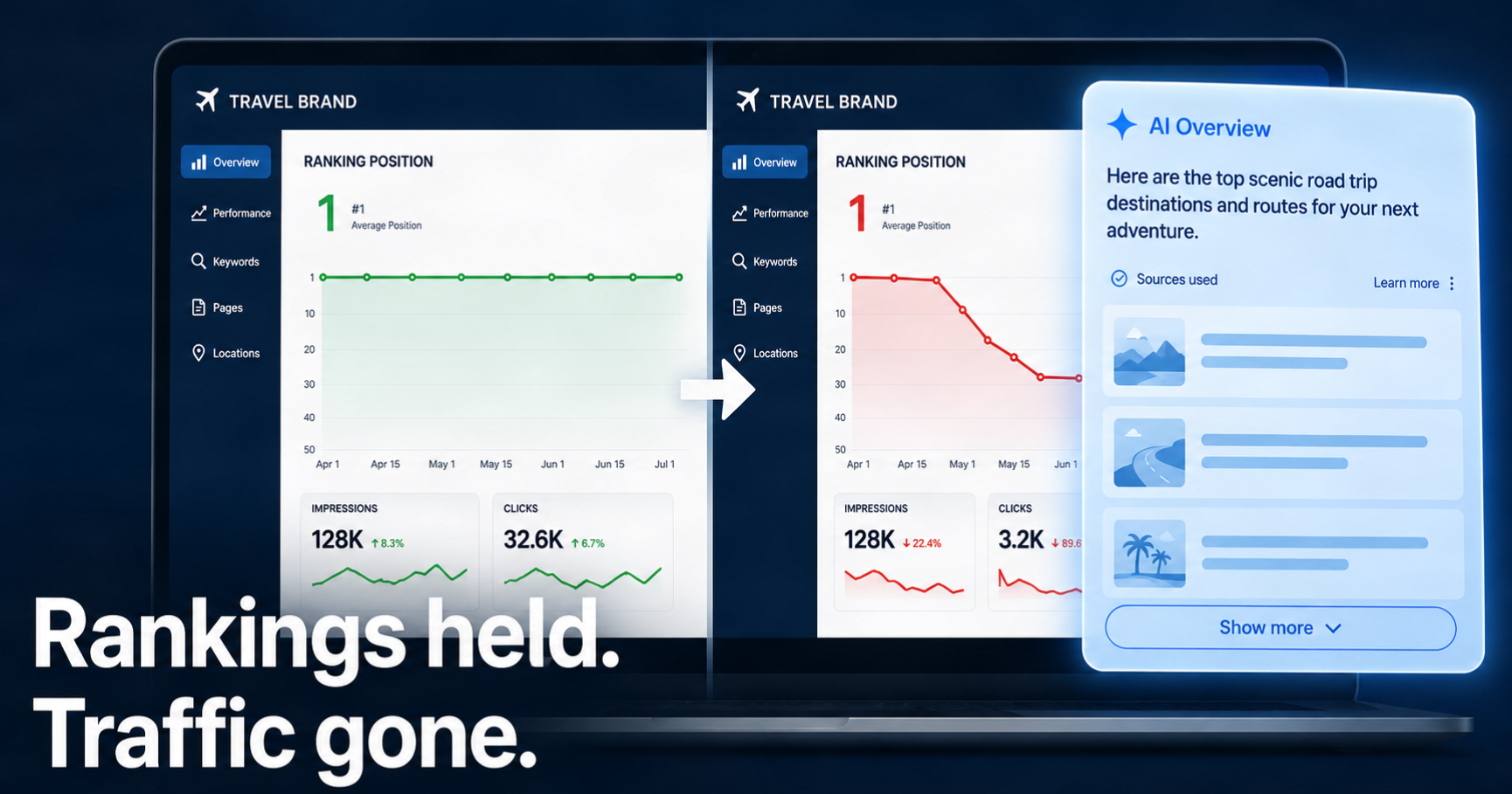
If your travel brand is not appearing in AI search, you are not alone. Your travel website ranks on page one. Your content is live. Your technical SEO is clean. And your organic traffic has fallen by 30% in the past twelve months.
For many travel businesses, that gap is a travel brand not appearing in AI search problem, not a Google rankings problem.
If that sounds familiar, you are not alone. And critically, you are not imagining it. Something has changed. Your rankings are not the problem. The problem is that the journey travellers used to take to reach your website has quietly moved somewhere else.
Understanding where it went, and how to follow it, is the difference between a travel brand that grows in 2026 and one that watches its digital presence slowly hollow out while the numbers look fine on the surface.
Your travel brand not appearing in AI search is now one of the most commercially significant problems in digital marketing.
How AI has changed the way travellers find travel brands
For nearly two decades, travel discovery followed a predictable path. A traveller typed a destination query into Google, clicked through four or five results, compared options across multiple websites and eventually landed on a booking page.
The whole journey happened through organic search and the travel brands with the strongest SEO owned the most visible positions in that funnel.
That model has not disappeared. But it has fractured significantly.
According to research from TakeUp AI, 38% of travellers have now actively used AI for trip planning, and among those who have, adoption accelerates quickly. A separate study from Phocuswright puts the figure higher, at 56% of travellers using AI tools at some stage of the planning process. However you measure it, the direction of travel is unambiguous.
When a traveller asks ChatGPT, Google AI Overviews, Perplexity or Gemini for destination recommendations, the AI does not return ten blue links. It generates a synthesised answer naming three to five travel brands directly.
The journey that used to pass through your organic result now ends inside an AI tool, with a shortlist that either includes you or does not.
According to Gartner, traditional search engine volume is forecast to decline 25% by the end of 2026.
At the same time, research published by AIVO in 2026 found that over 55% of keywords travel brands rank for on the first page of Google now trigger an AI Overview, up from 12% just eighteen months earlier.
Top-of-funnel travel content is seeing organic traffic declines of between 50% and 80% despite page one rankings holding steady. A travel brand not appearing in AI search can still rank on page one. They are no longer the same measure.
The traffic has not gone to a competitor. It has been absorbed above your results by AI systems that are now answering the question before anyone reaches your website
Is your travel brand not appearing in AI search?
Most travel marketers assume that strong Google rankings prevent a travel brand not appearing in AI search. The data does not support that assumption.
Research from Ahrefs, analysing 863,000 keywords and 4 million AI Overview citations, found that only 38% of AI Overview citations come from pages ranking in Google’s top ten.
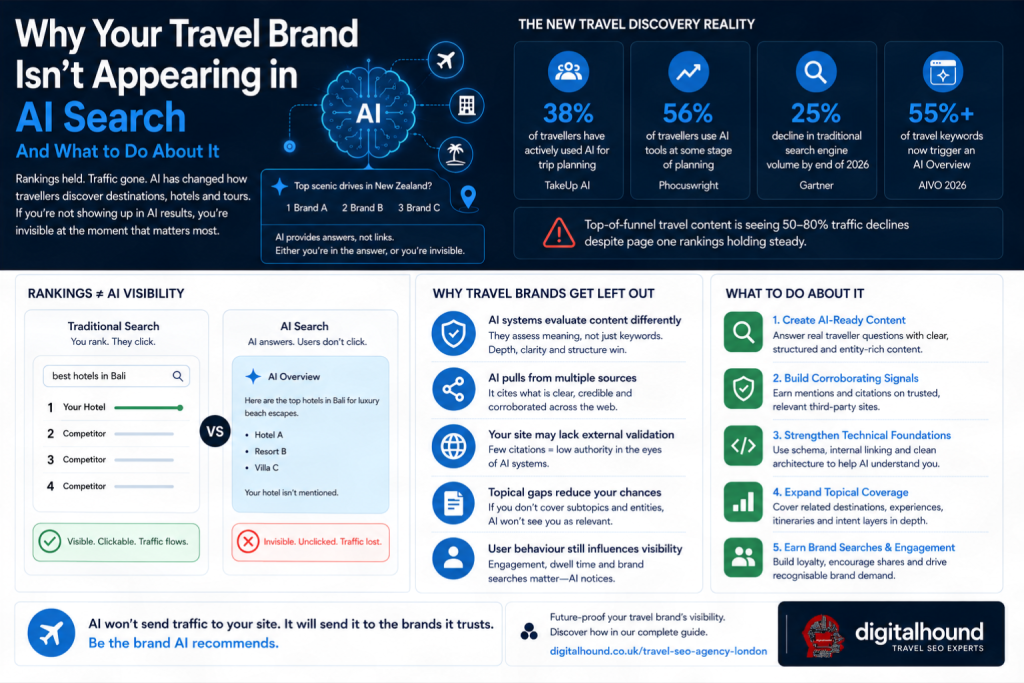
That figure was 76% just seven months earlier. The overlap between page one rankings and AI citations is collapsing. This is the structural reason behind travel brand not appearing in AI search results in 2026.
A travel brand can hold position one for its core destination queries and still be completely absent when a traveller asks AI for a recommendation in that category.
1. AI systems evaluate content differently from Google
Google ranks pages based on relevance signals, backlinks and authority tied to specific URLs. AI systems synthesise answers by pulling from training data, live retrieval and third-party citations, then selecting brands based on how consistently they appear across trusted sources.
Your rankings tell Google where to position your page. They do not tell AI systems whether to cite your brand. These are different systems operating on different signals, and optimising for one does not automatically optimise for the other. Fixing a travel brand not appearing in AI search requires a deliberate, separate strategy.
2. Your content is not structured for machine extraction
AI systems do not read travel content the way a human visitor does. They look for clean, direct, quotable information. A sentence that says we offer a range of tailored holiday experiences across Europe is invisible to an AI system because it contains no extractable answer to a specific question.
A sentence that says we are a specialist walking tour operator running small-group cultural tours in Spain, France and Portugal for groups of eight to twelve people gives AI a concrete, specific statement it can extract, verify and cite.
The distinction matters at every level of your website. The first 100 to 150 words of every key page are doing outsized work under the current AI retrieval models.
If those words do not clearly define what your travel brand is, who it serves and what specific type of travel experience it offers, travel brand not appearing in AI search becomes the likely outcome.
3. Your entity signals are inconsistent or absent
AI systems build their picture of your travel brand from multiple sources across the web. Your own website, your Google Business Profile, your listings on review platforms, mentions in travel media, references in travel blogs and editorial coverage all contribute to how confidently an AI system can describe and recommend you.
Schema markup, consistent NAP data and a clear Google Business Profile are what prevent your travel brand not appearing in AI search in 2026. They are the infrastructure that makes your entity legible to the systems doing the recommending.
4. Your brand lacks third-party citation density
Research published by Metricus in 2026 was blunt on this point: individual hotels, boutique operators and regional tour operators simply do not exist in AI-generated travel advice.
The reason is citation density. Booking.com has indexed data on 29 million properties. TripAdvisor has over a billion reviews. An independent operator with a few hundred web mentions cannot compete for AI mindshare on volume alone.
The travel brands winning AI recommendations today are not always the largest. According to AIVO Research, lifestyle brands with strong editorial coverage, clear positioning and structured digital presence consistently earn top AI positions even with a fraction of the mention volume that major chains have.
The methodology outranks the marketing budget when the content and citation strategy is right.
5. You have never measured your Citation Share
Citation Share is the most direct diagnostic available for travel brand not appearing in AI search. It is the proportion of AI-generated search answers in which your travel brand is named as the authoritative source for your most commercially important destination and experience queries.
Most travel brands have a Citation Share of zero for their core queries. Most have never checked.
Testing your Citation Share takes twenty minutes. Open ChatGPT, Google AI Overviews, Perplexity and Gemini. Run your ten most commercially important destination and experience queries across all four platforms. Note which travel brands are named and whether yours appears.
For more on how to measure and improve your Citation Share, read our guide to what Citation Share means for your travel brand.
6. Each AI platform operates differently
Research from AIVO found that Perplexity favours alternative accommodations and retrieves live web results, making it responsive to current content and strong editorial coverage.
ChatGPT relies more heavily on training data and skews toward established chains. Gemini is deeply integrated with Google’s index, meaning brands with strong traditional SEO perform better there.
Google AI Overviews pull from a combination of organic rankings, featured snippets and structured content.
A travel brand absent from two of the four major AI platforms faces travel brand not appearing in AI search across the platforms where booking decisions are increasingly being made.
The opportunity most travel brands are missing
Buried inside the travel brand not appearing in AI search problem is a genuine competitive opportunity that most travel marketing teams have not yet identified.
AI rewards specificity. Major hotel chains and large OTAs have a significant advantage in raw mention volume. Booking.com appears in 55% of AI-generated travel recommendations and Expedia in 54%, according to AIVO Research published in April 2026. Competing on volume is not realistic for most independent travel brands.
But according to research published by Hospitality Net in May 2026, independent operators outperform chains precisely because of the things that make them independent: a specific location, a distinct character, an owner with a point of view, experiences that are actually different from each other.
A boutique hotel in Seville with a rooftop terrace and a focus on flamenco culture, described in those specific terms consistently across its website, its OTA profiles and its editorial coverage, gives AI systems something concrete, specific and memorable to extract and recommend.
The window to address travel brand not appearing in AI search in your specific niche is not permanently open. The travel brands structuring their content and building their entity signals now are compounding an advantage that becomes harder to close over time.
What can you do about your travel brand not appearing in AI search?
The structural work required is not a complete rebuild. In most cases it involves five targeted areas.
Step 1: Audit your current Citation Share
Run your ten most commercially important destination and experience queries across ChatGPT, Google AI Overviews, Perplexity and Gemini. Document which brands appear, in what position and with what context. This is your baseline. You cannot address travel brand not appearing in AI search without first measuring it.
Step 2: Restructure your key pages for AI extraction
The first 150 words of every key page on your travel website should contain a direct, specific statement of what your brand is, who it serves and what specific travel experience or destination you specialise in. Avoid vague positioning language. Use question-format headings and H2s throughout. Answer the question directly and completely within 40 to 60 words before expanding. Getting this right is fundamental to preventing your travel brand not appearing in AI search.
Step 3: Fix your entity signals
Consistent entity signals are what prevent your travel brand not appearing in AI search. Audit your brand name, address, contact details and positioning description across every platform where your travel brand appears.
Your own website, Google Business Profile, TripAdvisor, OTA profiles and social media bios should all be consistent. Add appropriate schema markup: TouristAttraction or LodgingBusiness schema for hotels, TouristTrip schema for tour operators, TravelAgency schema for travel agencies.
Step 4: Build third-party citation density in the right places
Identify the travel media, editorial publications and trusted sources that AI systems cite in your specific niche. For Gemini visibility, prioritise editorial travel media.
For Perplexity visibility, prioritise TripAdvisor review density and current editorial content. One well-placed feature in a high-authority travel publication drives more AI citation value than fifty directory listings.
Step 5: Monitor Citation Share monthly
The reasons for a travel brand not appearing in AI search shift as platforms evolve. Set a fixed monthly audit of your Citation Share across the four major platforms using the same query set.
Connect Citation Share movement to your traffic and booking data so you can see the commercial impact of improvement over time.
Frequently asked questions
Why has my travel website traffic dropped but my rankings have not changed?
AI Overviews and conversational AI tools are absorbing the traffic above your organic results.
When Google generates an AI Overview for a travel query, a significant proportion of users get their answer without clicking through to any website, including yours.
Your page one ranking is still there. The clicks are going elsewhere. This is a travel brand not appearing in AI search problem, not a ranking problem.
How do I get my hotel or tour operator to appear in Google AI Overviews?
The most reliable route is structured content that directly answers specific travel queries, consistent entity signals across all platforms, and editorial coverage in travel media Google trusts.
Schema markup and a well-maintained Google Business Profile also contribute. There is no guaranteed route but all of these improve the probability of citation significantly.
What is GEO and how does it affect travel brands?
GEO stands for Generative Engine Optimisation. It refers to structuring content, entity signals and authority so that AI systems can extract, verify and cite your travel brand in generated answers.
Where SEO optimises for ranked links, GEO optimises for preventing travel brand not appearing in AI search: being selected as the named source in an AI-generated response.
Does being recommended by AI actually drive bookings?
Yes. Research from TakeUp AI found that 78% of travellers say it is very or extremely important that travel brands appear in AI-generated recommendations, and 84% say a trusted AI recommendation would make them more likely to book a specific property.
Conversions from AI-generated recommendations are reported to be higher than from traditional organic clicks because AI has already done the vetting for the traveller.
Why is Booking.com always recommended by AI and not my property?
Booking.com appears in 55% of AI-generated travel recommendations because it has indexed data on 29 million properties and an enormous citation footprint across the web. Competing on volume is not realistic.
Competing on specificity is. A well-structured page describing your specific property, location and experience clearly and consistently will earn AI citations for the niche queries where Booking.com offers no meaningful differentiation.
Do small tour operators and boutique hotels stand a chance in AI search?
They have a genuine content advantage if they use it. The fix for travel brand not appearing in AI search rewards specificity, and independent operators have specificity that chains cannot replicate.
The operator running small-group food tours in Palermo, described in clear and consistent terms across their website and in relevant editorial coverage, can earn AI citations for that specific type of travel experience that no global platform will ever match.
What is Citation Share and how do I measure it for my travel business?
Citation Share measures how often your travel brand is named as the authoritative source in AI-generated answers for your most commercially important destination and experience queries.
To measure it, run your ten most important queries across ChatGPT, Perplexity, Gemini and Google AI Overviews and document whether your brand appears. That is your Citation Share baseline.
How long does it take to fix your travel brand not appearing in AI search?
Entity verification and schema improvements can show movement within weeks as Google recrawls updated pages. Content restructured for AI extraction typically shows Citation Share improvement within one to three months.
3rd-party citation building through editorial coverage takes longer but produces the most durable fix for travel brand not appearing in AI search. Setting a Citation Share baseline from month one gives you a measurable trajectory from the start.
Is your travel brand not appearing in AI search?
We work with travel brands to audit Citation Share, restructure content for AI extraction and build the entity signals that produce verifiable results. If your travel brand not appearing in AI search is affecting your enquiries, visit our travel SEO agency London page and find out what a Citation Share audit looks like for your business.


Digitalhound's work spans technical SEO, AI-assisted content strategy, conversion optimisation and brand authority. The agency's content has achieved first page Google rankings against globally recognised publishers including Search Engine Land, TripAdvisor and Saga Holidays.
Darryl is a sought-after speaker at digital marketing conferences and has worked with clients ranging from independent law firms to FTSE-listed businesses. He writes on the intersection of AI, search strategy and commercial communication.
Digitalhound | 207 Regent Street, London W1B 3HH | digitalhound.co.uk | content@digitalhound.co.uk | 020 7873 2476

The point about rankings staying stable while traffic drops really stood out because a lot of travel brands are still measuring success with outdated SEO metrics. AI search is clearly changing how users discover destinations and services, so brands that focus only on traditional rankings could miss a huge visibility gap even if their site technically performs well.
Glad you think so too. AI search and in particular AI Overviews have changed the way people find and interact with information and travel brands are are yet to truly grasp this change.