Table of Contents
There is a quiet structural flaw inside many ecommerce SEO strategies, and it rarely shows up in dashboards.
Traffic is growing. Rankings improve. Keyword coverage expands. Index counts rise. The marketing reports look busy and the charts go up and to the right.
Revenue, however, does not move at the same pace. Or it grows, but far below its potential.
This disconnect is not accidental. It is the natural outcome of a visibility-first ecommerce SEO strategy. When the primary objective is broader exposure rather than commercial alignment, growth becomes surface-level. Metrics look strong. Margin does not.
A serious ecommerce SEO strategy should not begin with, “How do we rank for more terms?” It should begin with, “How does organic search compound revenue efficiently, month after month?”
If that sounds obvious, good. In practice, most teams still optimise for the easiest wins to report, not the hardest wins to bank.
The Visibility bias in Ecommerce SEO
Visibility is not the enemy. The bias is treating visibility as the finish line.
In ecommerce, it is painfully easy to create growth that looks impressive and performs poorly. Add a few hundred supporting pages. Expand a few categories. Publish informational content at pace. Push long-tail coverage. Let filters index. Watch the footprint expand.
The visible outputs are immediate:
- More impressions
- More ranking movement
- More pages indexed
- More sessions
Yet the commercial outcome often stays stubbornly flat because the visibility is concentrated in the wrong places.
When SEO is visibility-led rather than revenue-led, three patterns show up again and again.
First, traffic accumulates on low-commercial pages. Buying intent is diluted by research intent. The SEO report shows growth, yet revenue per session declines.
Second, authority fragments. Internal links point everywhere. Commercial category pages compete with adjacent subcategories and informational content. Search engines distribute weight across a wider surface area rather than concentrating it where revenue is generated.
Third, measurement becomes skewed. SEO performance is celebrated in sessions rather than contribution to profit. A rising traffic graph masks stagnant commercial performance.
This is not a technical failure. It is a strategic framing error inside the ecommerce SEO strategy itself.
What a revenue-first ecommerce SEO strategy prioritises
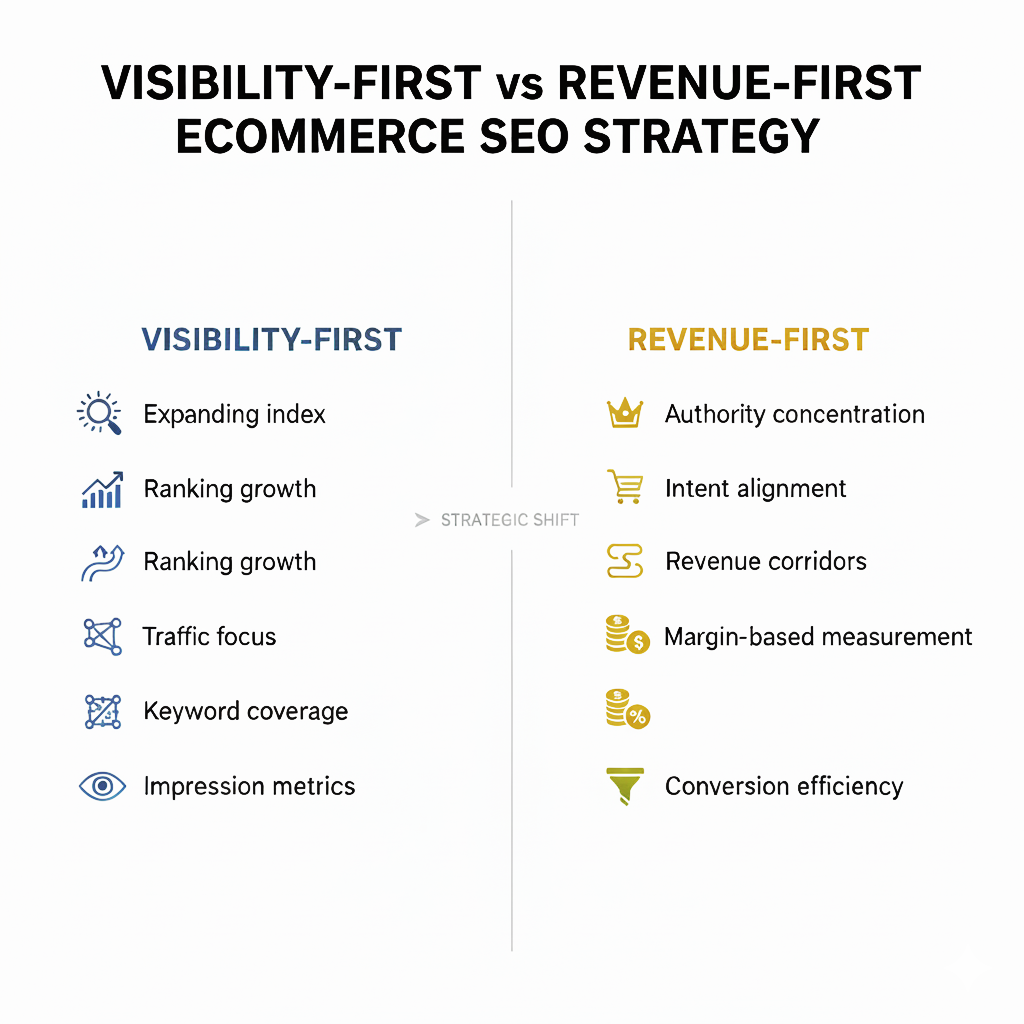
A revenue-first ecommerce SEO strategy inverts the traditional model.
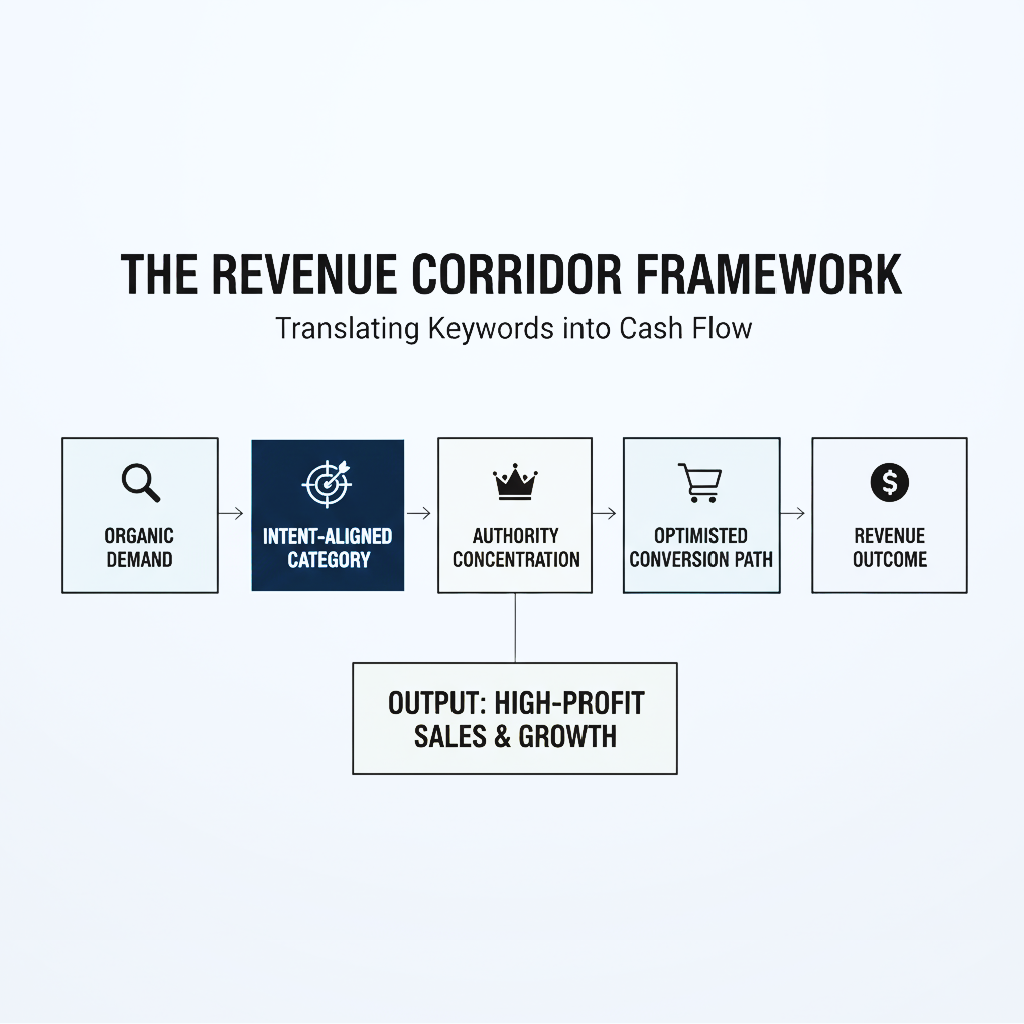
Instead of scaling coverage first, it maps revenue corridors. A revenue corridor is the intersection between organic demand, commercial margin, conversion potential, and structural authority.
That corridor becomes the organising principle for:
- Category architecture and navigation
- Internal linking hierarchy
- Indexation control and crawl focus
- Supporting content development
- Authority acquisition and PR-led links
This is where you stop treating SEO as “more content” and start treating it as “more commercial leverage.”
The practical difference is simple: the pages you want to rank are the pages you want to monetise. Everything else exists to support those pages, not to compete with them.
1) Intent-led category architecture
Most ecommerce category structures are historical artefacts. They reflect product teams, legacy merchandising decisions, supplier constraints, or internal taxonomy. That is not the same as reflecting how people search.
A revenue-first ecommerce SEO strategy starts by mapping categories to intent clusters. Not keywords in isolation, but clusters that represent buying journeys.
That typically means:
- Consolidating overlapping categories that cannibalise each other
- Building parent and child category relationships that mirror search intent
- Ensuring the primary category pages target purchase intent, not generic definitions
- Using supporting content to answer objections and narrow choices, then pushing users back to commercial pages
The goal is not to create more pages. The goal is to create fewer, stronger commercial pages that own demand.
2) Authority concentration
Authority is not a number in a tool. Authority is the ability of a specific URL to win a specific auction in Google.
When authority is spread across hundreds of near-duplicate URLs, filter pages, tag archives, outdated promo pages, and thin supporting content, your best commercial pages are forced to compete with your own noise.
A revenue-first model concentrates authority deliberately:
- Internal links flow toward margin-critical categories
- Supporting content links upward to money pages with intent-aligned anchors
- Low-value pages are no-indexed, canonicalised, merged, or removed
- External link acquisition is mapped to commercial corridors, not vanity pages
This is why the model is selective. It is designed to create “strong pages” rather than “many pages.”
3) Crawl focus and index discipline
Index bloat is one of the most expensive invisible problems in ecommerce. It rarely looks like a crisis because the site still ranks for something.
But when search engines waste crawl attention on low-value pages, new and updated commercial pages are discovered more slowly, re-evaluated less frequently, and compete inside a diluted index.
A revenue-first ecommerce SEO strategy treats the index as an asset, not a dump.
That means controlling:
- – Faceted navigation and filter indexation
- – Parameterised URLs
- – Site search result pages
- – Duplicate product variants
- – Legacy campaign pages
- – Thin category pages that exist only for internal reasons
Done properly, this reduces noise, improves crawl efficiency, and increases the probability that commercial updates translate into ranking improvements quickly.
Measuring ecommerce SEO performance beyond traffic
Measurement is where most ecommerce SEO strategies fail, because measurement drives behaviour.
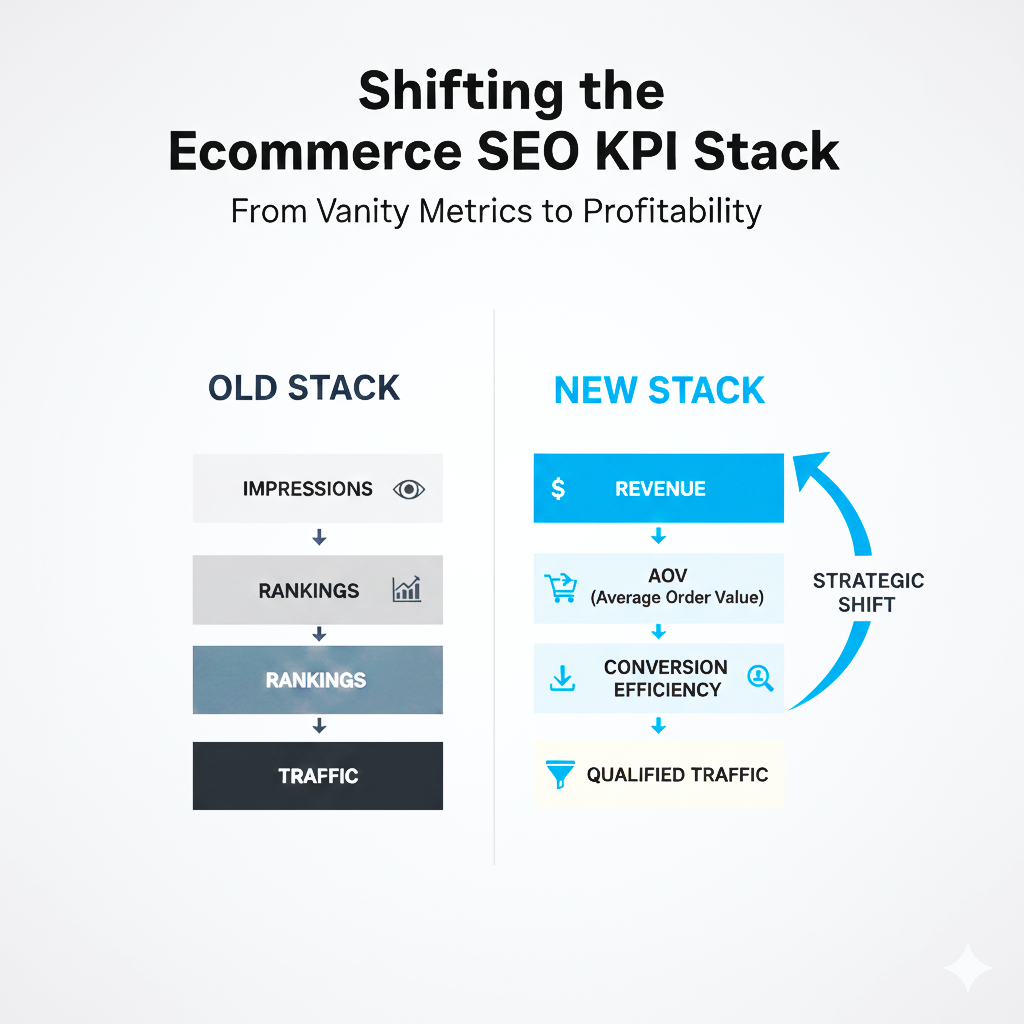
A visibility-led KPI stack looks like this:
Impressions → Rankings → Traffic
A revenue-first ecommerce SEO performance model looks like this:
Revenue → Average Order Value → Conversion Efficiency → Qualified Traffic
The difference is structural.
When revenue sits at the top, optimisation becomes sharper. Pages that attract traffic but fail commercially are deprioritised. Internal linking is adjusted to concentrate authority on margin-critical categories. Content investment is guided by commercial return, not surface demand.
Two quick examples of what changes when measurement changes:
- A blog post that drives 20,000 sessions but never assists a transaction stops being a “win.” It becomes a distribution channel that must feed commercial pages.
- A category page that converts at 0.4 percent but targets high-margin products becomes a priority even if its traffic is modest, because improving conversion efficiency and ranking position has outsized revenue impact.
Why visibility-led ecommerce SEO breaks at scale
As ecommerce brands scale, complexity compounds.
Category trees expand. Filters multiply. Seasonal collections create temporary URLs. Promotional pages remain indexed long after campaigns end.
Blog content grows independently of commercial structure. Marketplace integrations create duplicate variants. Pagination and sorting create more crawl surfaces.
A visibility-led ecommerce SEO strategy encourages this expansion because scale looks like progress.
But search engines allocate crawl attention and authority across the entire indexable footprint. When that footprint contains a high proportion of low-commercial-value pages, authority disperses.
High-margin categories compete internally with peripheral content.
This is where disciplined competitors gain ground. A revenue-first ecommerce SEO strategy does not attempt to outrank competitors everywhere. It focuses on outranking them where margin and demand intersect.
That alignment produces disproportionate commercial returns and is often achievable even against brands with larger budgets.
A practical illustration: traffic up, revenue flat
Picture a mid-sized ecommerce retailer with 12,000 indexed URLs.
Organic traffic has grown 28 percent year-on-year. Rankings have expanded across informational and comparison-based queries. The team celebrates ‘SEO growth’.
Revenue has grown only 8 percent.
On investigation, three things are usually true:
– The highest-traffic pages are informational and do not route users back to commercial categories.
– High-margin category pages sit on page two for purchase-intent queries because authority is diluted.
– Filter and parameter pages are indexed, creating duplication and internal competition.
A revenue-first ecommerce SEO strategy would do the unsexy work:
- Consolidate internal links toward margin-critical categories
- De-index redundant filters and parameterised duplicates
- Rework category copy and templates to match buying intent and remove friction
- Use supporting content to answer objections and push users back into commercial paths
- Acquire authority in ways that specifically benefit revenue corridors
Within months, traffic may stabilise or even dip slightly. Revenue, however, increases faster because organic visibility is now concentrated in commercially aligned corridors.
This is the trade-off visibility-first models avoid and revenue-first models embrace.
Common failure modes that kill ecommerce growth
If you want to pressure-test whether your ecommerce SEO strategy is visibility-led, look for these tell-tales:
– Your top landing pages are guides, not categories
– Your highest-margin categories have weak internal link support
– You have thousands of indexed URLs with negligible traffic and no sales
– Your reporting highlights rankings and sessions before revenue and AOV
– Your content calendar is detached from commercial priorities
None of these are ‘SEO mistakes’ in isolation. They are symptoms of a strategy optimised for visibility rather than commercial leverage.
A short counterargument, and why it fails
The common pushback is: “We need top-of-funnel content to build trust and grow demand.”
True. But top-of-funnel content is only an asset when it is structurally connected to commercial pages.
If supporting content is allowed to become an end in itself, it becomes a traffic sink. It absorbs authority, inflates reporting, and starves category pages that actually convert.
Revenue-first does not mean ‘no informational content’. It means ‘informational content with a job’. The job is to strengthen revenue corridors.
Conclusion: visibility is necessary, not sufficient
Visibility is required. It is not the end goal.
If your ecommerce SEO performance looks healthy but revenue growth feels constrained, the issue may not be exposure. It may be distribution of authority and intent alignment.
A revenue-first ecommerce SEO strategy does not attempt to rank everywhere. It aims to dominate where commercial leverage exists.
In competitive ecommerce markets, that difference determines whether organic search becomes a reporting channel or a growth engine.