If you run a travel business and your website isn’t showing up on Google, you already know how frustrating that feels. You’ve probably tried a few things.
Maybe you hired an agency that promised page one rankings and delivered nothing but excuses. Or perhaps you’ve been tinkering with keywords yourself, hoping something would stick.
Here’s the thing: SEO for travel websites is genuinely difficult. The competition is fierce. You’re up against massive OTAs with marketing budgets that dwarf most companies’ entire revenue. And Google has become incredibly sophisticated at working out which travel sites deserve to rank and which don’t.
But it’s far from impossible. Whether you’re running a boutique tour operator, a car rental agency, a cruise line, or an online travel platform, the principles remain the same. Get them right, and you’ll see genuine, sustainable growth in organic traffic.
Why SEO Matters More Than Ever for Travel Brands
The numbers tell a compelling story. According to Phocuswright’s Global Travel Market Report, global travel bookings hit $1.6 trillion in 2024, with online channels accounting for roughly 65% of all bookings. That figure is expected to keep climbing.
What does this mean for your business? Simply put, if potential customers can’t find you online, they’re booking with someone else. And with 72% of travellers now preferring to book online rather than through traditional agencies, your website isn’t just a digital brochure.
It’s your shopfront, your sales team, and your brand ambassador all rolled into one.
The travel industry also has a unique challenge: seasonality. Search volumes fluctuate wildly depending on the time of year, holidays, and even world events. A solid SEO foundation means you’re ready to capture that traffic when demand surges, rather than scrambling to catch up while your competitors hoover up bookings.
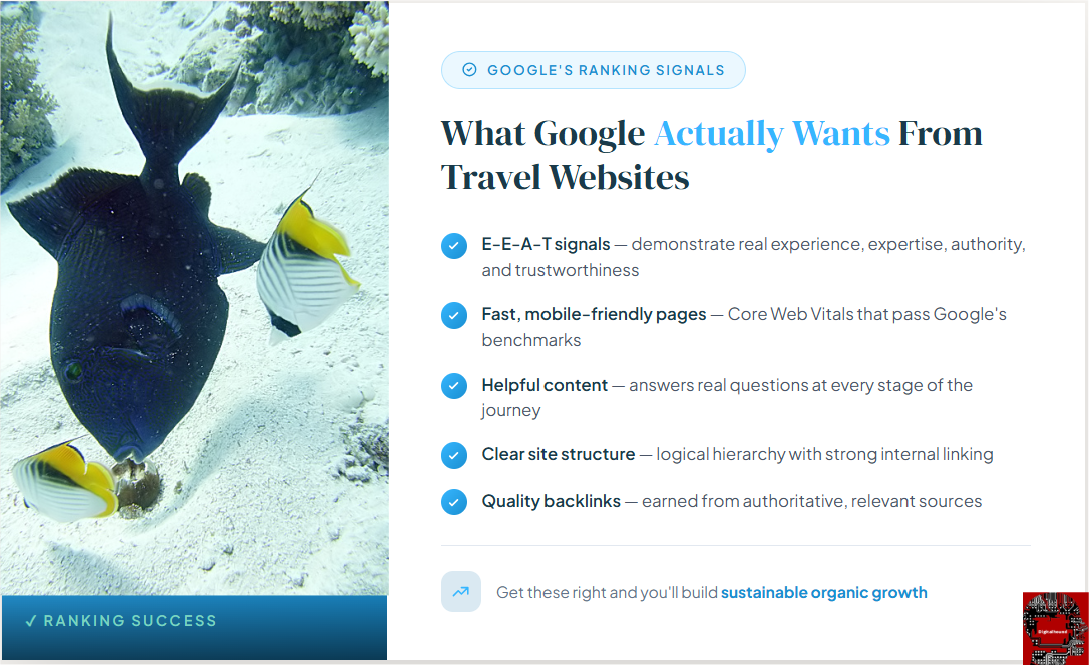
What Google Actually Wants From Travel Websites
Let’s cut through the noise. Google’s algorithm uses hundreds of ranking factors, but for travel websites, a handful matter far more than the rest.
E-E-A-T: Experience, Expertise, Authority, and Trust
Google updated its quality guidelines in late 2022 to add “Experience” to the existing E-A-T framework. As Google’s official documentation explains, they want to see content “produced with some degree of experience, such as with actual use of a product, having actually visited a place, or communicating what a person experienced.”
For travel websites, this is particularly significant. Google specifically mentions travel guides as an example where first-hand experience matters. A destination guide written by someone who’s actually walked those streets, eaten in those restaurants, and navigated those transport systems will always outperform generic content cobbled together from other sources.
This doesn’t mean every piece of content needs a personal narrative. But it does mean your website should demonstrate genuine expertise in your niche. If you specialise in Mediterranean cruises, your content should reflect that depth of knowledge. If you run adventure tours in Patagonia, readers should feel your familiarity with the terrain.
Technical Performance
Travel websites often struggle here. Rich imagery, interactive booking systems, and complex filtering options can make pages bloated and slow. But Google has made site speed a ranking factor, and users won’t wait around for sluggish pages to load.
Mobile performance matters enormously too. With roughly half of all travel research now happening on smartphones, a site that looks beautiful on desktop but falls apart on mobile is leaving money on the table.
Core Web Vitals, Google’s specific metrics for page experience, should be on your radar. These measure loading performance, interactivity, and visual stability. If your booking engine causes layout shifts or takes ages to become interactive, that’s hurting your rankings.
Content That Serves a Purpose
Google has become remarkably good at understanding user intent. When someone searches “best time to visit Santorini,” they want practical information about weather, crowds, and pricing, not a hard sell on your package deals.
The most successful travel websites create content that genuinely helps at each stage of the booking journey. Inspiration content for dreamers. Planning content for researchers. Detailed product pages for people ready to book. And post-booking content that builds loyalty.
Practical SEO Strategies for Travel Websites
Now for the bits you can actually implement. These aren’t theoretical concepts; they’re tactics that work in the real world of travel SEO.
Get Your Site Structure Right
Travel websites can become sprawling messes without careful planning. You might have thousands of destination pages, countless tour variations, and a blog that’s grown organically over years.
A clear hierarchy helps both users and search engines. Group related content logically. Create hub pages that link to more specific content. Make sure every important page is reachable within three clicks from the homepage.
Internal linking deserves serious attention. When you mention a destination in a blog post, link to your main page for that destination. When your Bali page discusses nearby islands, link to your Lombok and Gili content. This distributes authority throughout your site and helps Google understand the relationships between pages.
Target the Right Keywords
Keyword research for travel is nuanced. Yes, “cheap flights to Spain” gets enormous search volume, but you’re not going to outrank Skyscanner or Google Flights for that term.
Instead, think about what makes your offering distinctive. Long-tail keywords with clear commercial intent often convert better anyway. “Luxury Maldives honeymoon packages with overwater villa” has far fewer searches than “Maldives holidays,” but the person typing that query knows what they want and is closer to booking.
Don’t ignore informational queries either. “Do I need a visa for Thailand from UK” or “best time to see cherry blossoms in Japan” are opportunities to be helpful and get in front of potential customers early in their planning.
Build Destination Content That Stands Out
Every travel website has destination pages. Most are forgettable. The ones that rank share common traits: they’re comprehensive without being padded, they answer real questions, and they offer perspectives you won’t find elsewhere.
Include practical details: best areas to stay, realistic budgets, local customs worth knowing. Add your own insights from experience. Use original photography where possible, rather than the same stock images every other site uses.
Structure matters too. Clear headings, logical flow, and easy navigation help both readers and search engines. Schema markup for travel-related content can help you appear in rich results and knowledge panels.
Earn Quality Backlinks
Link building in travel can feel like pushing water uphill. Everyone wants links, and the obvious targets (travel publications, tourism boards) receive countless pitches.
But authoritative backlinks remain one of the strongest ranking signals. The key is creating content worth linking to. Original research, detailed guides, interactive tools, or genuinely useful resources attract links naturally.
Think about what journalists and bloggers actually need. Data they can cite. Expert quotes they can include. Resources they’d recommend to their readers. Position yourself as a helpful source rather than just another business asking for favours.
Optimise for Local Search
If you have physical locations or serve specific geographic areas, local SEO is essential. Your Google Business Profile should be complete and accurate. Reviews matter enormously, both in quantity and how you respond to them.
Local citations across directories help establish your presence. And location-specific content (“things to do in [your city]” style guides) can capture traffic from visitors already in your area.
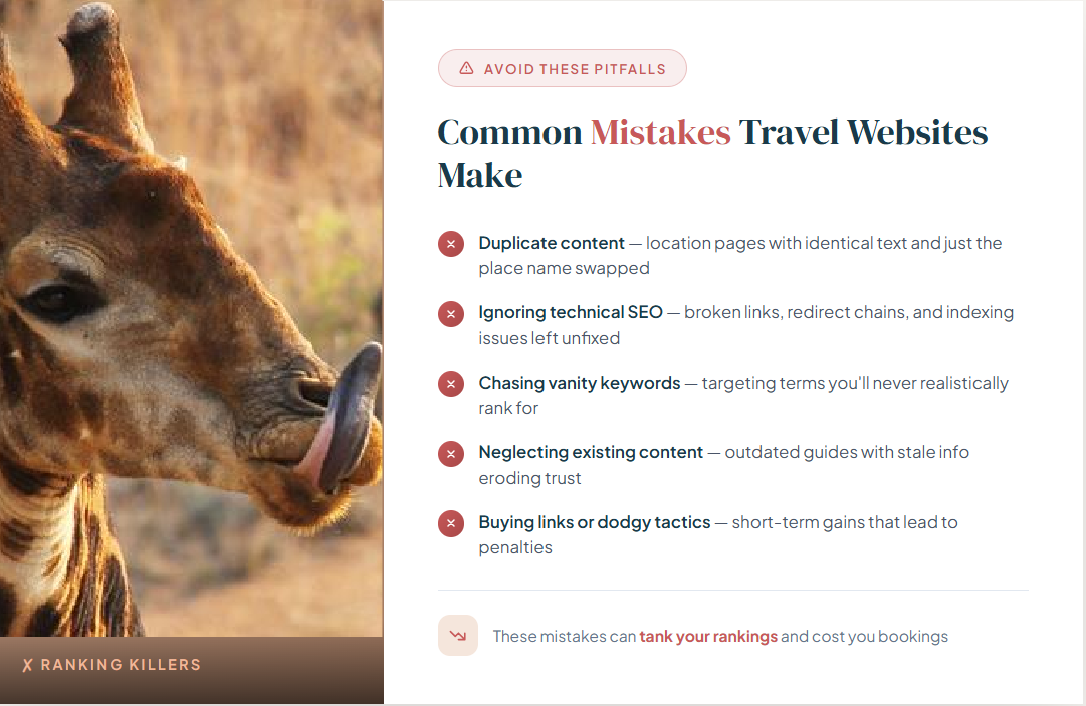
Common Mistakes Travel Websites Make
After working with travel brands for years, certain patterns emerge. Here are the pitfalls we see most often.
Duplicate content across location pages. If your Spain page and Portugal page share 90% of their text with just the country name swapped out, Google notices. Each page needs unique, valuable content.
Ignoring technical SEO. A beautiful website means nothing if search engines can’t crawl it properly. Broken links, redirect chains, missing meta data, and indexing issues are surprisingly common in travel sites with complex booking systems.
Chasing vanity keywords. Ranking for “holidays” would be nice, but it’s not realistic for most businesses. Focus on terms you can actually win and that lead to conversions.
Neglecting existing content. That Bali guide you wrote in 2019 might still rank, but outdated information erodes trust. Regular content audits and updates keep your pages relevant and accurate.
Buying links or using dodgy tactics. The travel industry has seen its share of link schemes and manipulative practices. Google has become expert at detecting these. Short-term gains inevitably lead to penalties.
When to Work With a Specialist Travel SEO Agency
Not every business needs an agency. If you have the time, inclination, and someone on your team willing to learn, you can make real progress yourself.
But there are scenarios where specialist help makes sense. If your site has technical issues beyond your team’s expertise. If you’ve been hit by a Google penalty. If you’re in a fiercely competitive market where marginal gains matter. Or simply if your time is better spent running your business than learning SEO intricacies.
If you’ve been burned by agencies before, I understand the scepticism. The industry has more than its fair share of cowboys making promises they can’t keep. The key is finding a partner who understands the travel sector specifically, communicates clearly about what they’re doing and why, and measures success by business outcomes rather than just rankings.
We’ve worked with tour operators, OTAs, cruise lines, and car rental companies across the UK and beyond. If you’d like to discuss how we might help your travel website perform better in search, learn more about our travel SEO services or get in touch for a no-obligation conversation.
Frequently Asked Questions
How long does it take to see results from travel website SEO?
Honest answer: it depends. Competitive terms in popular destinations might take 6-12 months or longer. Less competitive niches or long-tail keywords can show improvement within weeks. Technical fixes often have faster impact than content changes. Anyone promising guaranteed rankings in a specific timeframe should be treated with suspicion.
Is SEO still worth it when Google keeps changing things?
Absolutely. Algorithm updates tend to reward the same things over time: helpful content, good user experience, and genuine authority. Websites built on solid fundamentals weather updates better than those chasing quick wins. The specifics evolve, but the core principles remain remarkably consistent.
Should I focus on SEO or paid advertising?
Both have their place. Paid ads deliver immediate visibility and work well for time-sensitive promotions. SEO builds sustainable traffic over time and often delivers better ROI once established. Most successful travel businesses use a combination, with SEO reducing their dependence on increasingly expensive paid channels.
How do I compete with huge OTAs like Booking.com or Expedia?
You don’t compete directly on their terms. Instead, find your niche. Specialise in specific destinations, travel styles, or customer segments they serve poorly. Create content with depth and personality that corporate giants can’t match. Build relationships with customers who value expertise over the lowest price. Your size can be an advantage when it means agility and genuine care.
What’s more important: on-page SEO or backlinks?
Both matter, but in different ways. On-page SEO is foundational. Without solid technical setup, good content, and proper optimisation, backlinks won’t help much. Once your on-page elements are strong, quality backlinks become the differentiator that helps you outrank competitors with similar content.
How often should I update my travel content?
Anything time-sensitive (prices, opening hours, visa requirements) needs regular checking. Destination guides benefit from annual reviews at minimum. Blog posts about evergreen topics need less frequent updates but should still be checked for accuracy. Set a schedule that’s realistic for your team and stick to it.
Final Thoughts
SEO for travel websites isn’t magic, and anyone who tells you otherwise is selling something. It’s a combination of technical competence, quality content, and consistent effort over time.
The travel industry is more competitive than ever, but that also means the rewards for getting it right are substantial. A well-optimised website becomes an asset that delivers qualified traffic month after month, reducing your reliance on expensive advertising and building a direct relationship with customers.
Start with the fundamentals. Fix technical issues. Create content that genuinely helps your target customers. Build authority in your specific niche. And be patient, because sustainable rankings don’t happen overnight.
The journey matters, after all. That’s something every travel professional understands.


Digitalhound's work spans technical SEO, AI-assisted content strategy, conversion optimisation and brand authority. The agency's content has achieved first page Google rankings against globally recognised publishers including Search Engine Land, TripAdvisor and Saga Holidays.
Darryl is a sought-after speaker at digital marketing conferences and has worked with clients ranging from independent law firms to FTSE-listed businesses. He writes on the intersection of AI, search strategy and commercial communication.
Digitalhound | 207 Regent Street, London W1B 3HH | digitalhound.co.uk | content@digitalhound.co.uk | 020 7873 2476



Well researched & thoroughly useful tips & strategies for any online travel website. Well done!
Thank you. We’re really chuffed that you found it so useful John.
Very impressive blog hope you post again soon.
Thank you, just did a complete rewrite of this blog post. Perhaps you might want to read it again