It Will Amplify It.
The law firm communication problem is not what most firms think it is.
How plain English determines whether your firm wins or loses the instruction.
Here’s what this article covers:
Table of Contents
1. The Adoption Gap
In February 2026, a senior lawyer stood up in front of more than 500 General Counsels at a major in-house conference in Stockholm and delivered what may be the most important three words in legal technology right now.
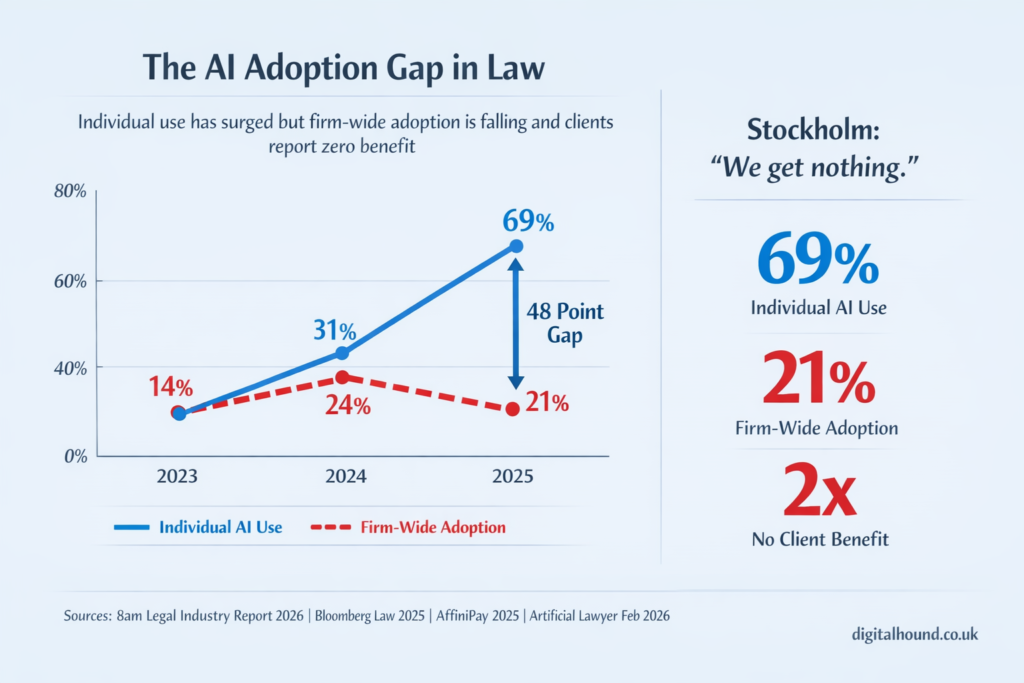
“We get nothing.” Senior In-House Lawyer, 500+ GC Conference, Stockholm, February 2026
The reaction from the room was quiet agreement.
Not surprise. Agreement.
The law firm communication problem is not a technology gap. This is where the legal sector’s AI story actually stands in 2026.
This is the law firm communication problem in its most visible form. Not a technology gap. A communication gap that technology is about to accelerate.
This is where the legal sector’s AI story actually stands in 2026. Individual adoption has exploded. In a single year, the proportion of legal professionals using AI personally more than doubled, from 31% to 69%.
Firms have invested in tools, platforms and pilots. The announcements have been confident. The promises significant.
And the clients are feeling nothing different.
Bloomberg Law’s 2025 State of Practice Survey found that across every category measured, the vast majority of attorneys reported no change as a result of AI in their firm. Firm-wide adoption actually fell slightly, from 24% in 2024 to 21% in 2025, even as individual use surged.
The gap between what firms are doing internally and what clients are experiencing externally is not a technology gap. It is a law firm communication problem that AI is not closing.
The firms solving the law firm communication problem and seeing genuine returns from AI investment share one characteristic that has nothing to do with which tools they chose, how much they spent, or how quickly they moved.
They were already communicating clearly before AI arrived.
Sources: 8am Legal Industry Report 2026 | Bloomberg Law State of Practice Survey 2025 | AffiniPay Legal Industry Report 2025 | Artificial Lawyer, Feb 2026
2. The Clarity Problem
Before any firm deploys AI for client-facing content, there is one question worth asking honestly. It is the question that reveals whether the law firm communication problem exists before the technology arrives.
If we feed our existing content into an AI system, what comes out the other side?
For most law firms, the answer is uncomfortable. More of the same. Faster.
The Legal Services Board’s consumer research tells us that 84% of legal clients want plain English from their firm. Yet 65% say they feel intimidated by the language they actually receive. That gap exists before AI.
It is not a technology problem. It is a law firm communication problem that technology is about to accelerate.
AI does not arrive into a vacuum. It mirrors what it is fed. Feed it passive-voiced, jargon-heavy, instruction-light content and it produces passive-voiced, jargon-heavy, instruction-light content. Only faster. And at greater volume.
This is the law firm communication problem made visible at scale.
The law firm communication problem has three distinct layers, and most firms are blind to all of them.
A survey of 460 lawyers identified communication as the skill most vulnerable to technological disruption in the profession. Not research. Not document review. Communication. The very thing clients say matters most.
The Clarity Problem has three layers, and most firms are blind to all of them.
The Accuracy Trap
Law firms write the way they do for good reason. Precision matters in legal work. But that same instinct applied to client-facing websites, onboarding letters and marketing content creates what we call the Accuracy Trap.
In trying to be legally watertight, firms become linguistically impenetrable. This is the first layer of the law firm communication problem.
The contrast is stark.
BEFORE“Notwithstanding any prior agreements, the firm shall commence the provision of legal services only upon receipt of the duly executed letter of engagement and the requisite payment on account.” 52 words. Post-Graduate reading age. Two Latin terms.
AFTER – AI Clarity Protocol applied “We will start your legal work as soon as you sign your letter and pay the deposit.” 18 words. Grade 6 reading age. Zero friction.
Same meaning. Same legal intent. One sounds like a partner. One reads like a contract. Feed the first version into AI and you get more of it.
The Passive Voice Default
AI defaults to passive, formal constructions because that is the dominant register of professional content online. “Assistance will be provided.” “Documents should be submitted.” “Advice may be sought.”
This is the language of institutions protecting themselves, not people helping clients. Communication researchers call it psychological distance. Clients call it off-putting, even if they cannot name why. It is the second layer of the law firm communication problem.
Research on conversational human voice shows that active, direct communication increases trust scores by 22% compared to formal corporate tones. In a market where clients choose between firms of similar capability, that difference matters.
Source: Jacob Tyler Brand Voice Study 2025
The Instruction Gap
Most legal website content tells clients what the firm does. It rarely tells clients what to do next. This is the third layer of the law firm communication problem and the one that costs instructions silently.
AI amplifies this because information is easier to generate than instruction. The result is more content that looks active but converts nothing.
Firms getting genuine value from AI have solved all three of these problems without AI first. The technology then amplifies something worth amplifying.
Sources: Legal Services Board Consumer Research 2024/25 | IE Insights, AI Can’t Negotiate, 2025

3. The Commercial Cost
This is not an abstract law firm communication problem. It has a direct commercial consequence that most firms are not tracking because they are not joining the right dots.
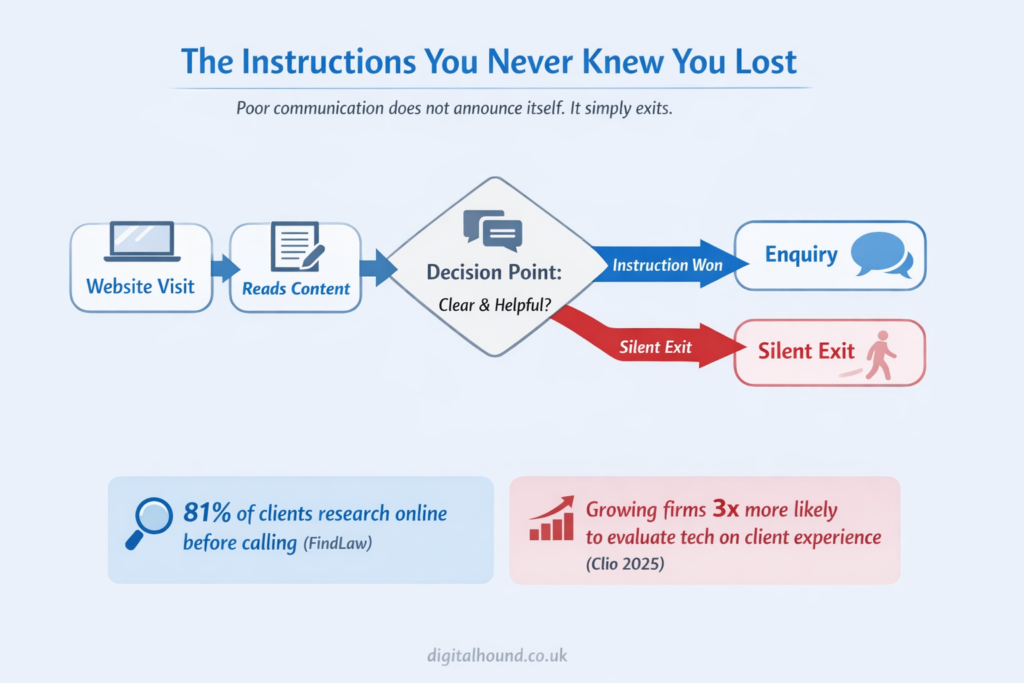
The commercial cost of the law firm communication problem is not abstract. 81% of people research legal services online before they pick up the phone. They arrive at a firm’s website with a real problem, often anxious, not legally trained, and looking for three things quickly.
Can this firm help me? Can I trust them? What do I do next?
What they typically find is a website built to impress other lawyers.
Complex language. Dense paragraphs. No clear next step. And within seconds, before a single human interaction, a decision is made. Not in your favour.
The Instructions You Never Knew You Lost
Most firms measure enquiries received. Very few measure the gap between visitors and enquiries. The silent majority who arrived, read something, felt nothing and left.
That is where the commercial cost lives. And it is invisible on any management report.
Back in Stockholm, those 500 General Counsels were not saying their firms’ AI tools were broken. They were saying the client experience had not changed. The investment was internal. The communication remained as it always was. Faster, possibly. Clearer, no.
The Compounding Effect
The law firm communication problem does not just cost the immediate enquiry. It compounds.
A client who struggles with their onboarding documents asks more questions and takes more fee earner time. A client who cannot follow a legal letter loses confidence regardless of the quality of the advice behind it. A client who receives no clear next step disengages.
AI producing more of this at greater volume does not improve any of those outcomes. It scales them.
What the Data Shows
Growing law firms are twice as likely to leverage technology effectively as stable firms and nearly three times more likely than shrinking ones. The differentiator is not the technology. It is how client-centrically it is deployed.
Firms that evaluate technology through the lens of client experience consistently outperform those that evaluate it on operational efficiency alone. Client clarity is not a soft metric. It drives revenue.
Source: Clio Legal Trends Report 2025
4. The Firms Getting It Right
The solution to the law firm communication problem does not require a new AI platform or a six-figure consultancy. The firms getting the most from AI share something surprisingly simple.
They invested in communication clarity first.
This is not correlation. It is cause and effect. AI amplifies the law firm communication problem that already exists in a firm’s culture. Give it clarity and it produces clarity at scale. Give it complexity and it scales complexity. The technology does not choose. It reflects.
Investing in People, Not Just Platforms
At the Intapp Amplify conference in early 2026, Bird & Bird CEO Christian Bartsch delivered a keynote on AI and strategic transformation. The central argument was not about which tools to deploy. It was about investing in people’s AI skills to elevate human capability.
That distinction matters. The firms seeing real transformation are not treating AI as a substitute for human communication. They are using it to amplify the human qualities that already differentiate them. Clarity of thought. Directness of voice. A genuine client-first approach in everything they produce.
These qualities are not what AI brings to a firm. They are what a firm must bring to AI.
A Quality Framework Worth Adopting
Matthew Leopold, Head of Marketing at LexisNexis UK, recently set out a four-step framework for evaluating AI output in legal contexts. It deserves wider adoption.
His framework asks four questions of any AI-generated legal content:
- Is it right? Is the law accurate, are the key facts correct, and can it be quickly validated?
- Does it make sense? Does it explain why, not just what? Does it show trade-offs and end with a clear recommendation?
- Is it useful to the client? Is it clear, structured and written for the end user? Does it say what happens next?
- Can you control it? Would two people in the firm produce broadly the same answer?
The third question is the one most firms stumble on before AI even arrives. If content is not clear, structured and written for the end user without AI, the technology does not fix that. It accelerates it.
The AI quality standard and the plain English standard are, in the end, exactly the same standard.
What It Looks Like in Practice
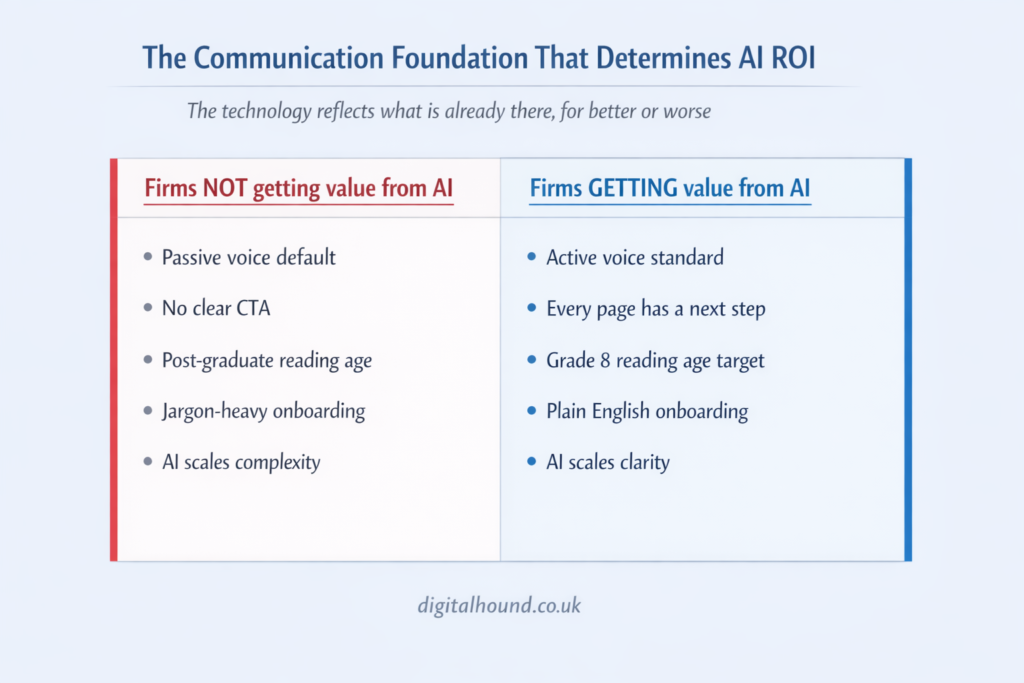
The practical difference between firms getting value from AI and those that are not is visible at the content level. High-performing firms share several characteristics:
- Active voice is the default, not the exception
- Every page ends with a specific, low-friction next step
- Reading age is tested and targeted at Grade 8 or below for all public-facing content
- Legal Latin and archaic terminology are absent from client communications
- Onboarding documents are written as instructions, not information
When AI is introduced into a firm operating at this standard, the results are measurable. Content production accelerates without quality degrading. Consistency improves across offices. Client communications that once required multiple drafts reach an acceptable standard on the first pass.
The technology earns its investment because the foundation was already there.
5. Where to Start
Firms waiting for AI to solve the law firm communication problem are waiting for the wrong thing. The sequence runs the other way. Communication clarity enables AI value. Not the other way around.
This is precisely why we developed the Human Moat content strategy, a framework for building the kind of original, verifiable content that AI systems trust and cite.
The starting point is not a technology decision. It is an honest audit of what your current communication is doing to your prospective clients.
Three questions cut through quickly.
- Does a non-lawyer, reading your homepage cold, know within 30 seconds what your firm does, who it is for and what they should do next?
- What percentage of your client-facing content is written in active voice? Tools like Hemingway App or Readable.com will audit this in minutes.
- Does every page on your website end with a specific, low-friction next step? Not a generic “Contact us” but a direct invitation that meets the client where they are.
If the honest answers are no, unclear or rarely, the foundation is not ready for AI. Deploying AI into that environment will not improve the answers. It will generate more content with the same problems at greater speed.
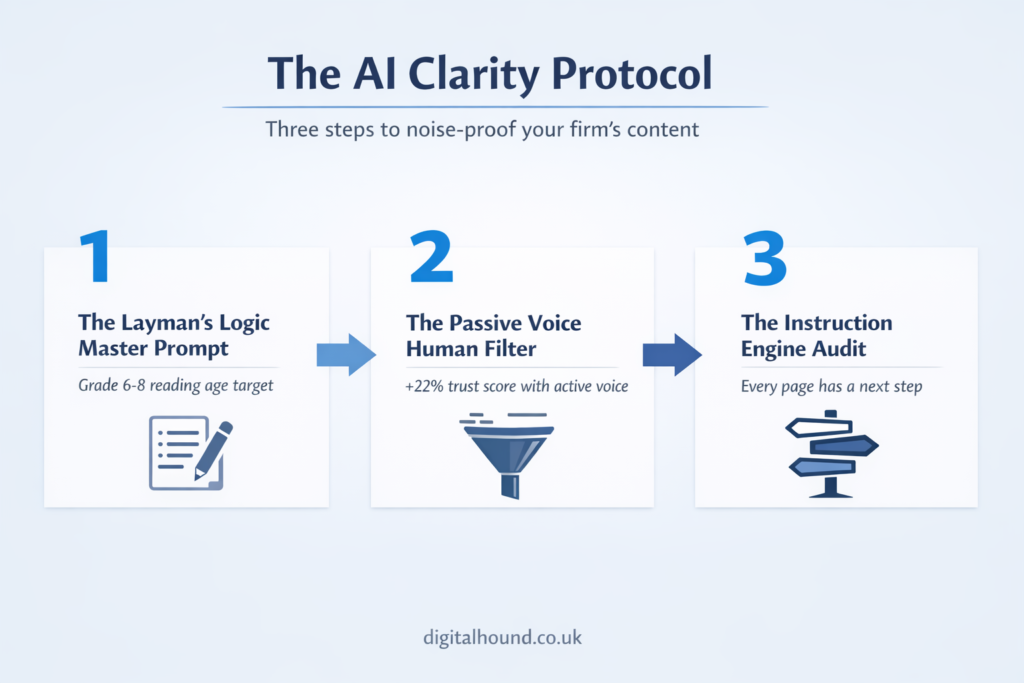
The AI Clarity Protocol
For firms ready to act immediately, we have developed a practical three-step framework that addresses the most common communication failures before and alongside AI adoption.
Step 1: The Layman’s Logic Master Prompt
Stop asking AI to “write a post” or “draft a letter.” Give it a specific instruction set that forces it to prioritise the client’s understanding. Specify: active voice only, no legal Latin, a maximum sentence length of 25 words, and instruction over information.
The result is content that consistently tests at a Grade 6 to 8 reading age without losing professional authority.
Step 2: The Passive Voice Human Filter
After any AI output, run a simple passive voice check before publication. Look for “is being,” “was held” and “will be provided.” Convert each one. “We do.” “We held.” “We provide.”
This single step, applied consistently, shifts the entire register of a firm’s communication from institutional to human. Research shows it increases trust scores by 22%. In a profession where trust is the primary currency, that is not a marginal gain.
Step 3: The Instruction Engine Audit
Go through every page of your client-facing digital presence and ask one question: does this page tell the reader exactly what to do next?
“See if you qualify for a fixed-fee consultation.” “Tell us about your situation and we will respond within two hours.” “Download our plain English guide to employment disputes.”
Every page without a clear next step is losing clients quietly and invisibly.
The Firms That Will Win
AI adoption in the legal sector is no longer a question of whether. It is a question of whether the law firm communication problem has been addressed first.
The firms that will derive genuine, lasting value from AI are not necessarily the ones moving fastest or spending most. They are the ones that understand the technology is only as good as the communication culture it runs on.
Plain English is not a nice-to-have. Instruction matters more than information. Trust is built in the language of the client, not the language of the courtroom.
The Stockholm conference sent a message that every law firm marketing director should take seriously. Five hundred General Counsels, asked what they were seeing from their firms’ AI investment, said they were seeing nothing.
Not because the technology is not capable. Because the communication foundation was not there for it to build on.
Plain English is the foundation. AI without clarity is just faster noise. The firms that crack communication first will get exponentially more from AI than those that don’t.
The law firm communication problem is solvable. But only by the firms willing to address the foundation before they add the technology.
The window to address the law firm communication problem and establish a genuine communication advantage is open right now. Understanding how AI systems discover and recommend law firms is the first step. Our LLM SEO for law firms service is built around exactly that.
As AI adoption accelerates and content volume increases across the profession, the firms that communicate with clarity and authority will stand out more, not less.
The noise will get louder. The signal will become more valuable.
The question is simply which one your firm is producing.
Want to know where your firm sits?
Digitalhound offers a Plain English Audit for law firm websites and client-facing content. We assess reading age, passive voice levels, instruction density and conversion readiness and tell you exactly what to fix first. Get in touch at content@digitalhound.co.uk or visit digitalhound.co.uk


Digitalhound's work spans technical SEO, AI-assisted content strategy, conversion optimisation and brand authority. The agency's content has achieved first page Google rankings against globally recognised publishers including Search Engine Land, TripAdvisor and Saga Holidays.
Darryl is a sought-after speaker at digital marketing conferences and has worked with clients ranging from independent law firms to FTSE-listed businesses. He writes on the intersection of AI, search strategy and commercial communication.
Digitalhound | 207 Regent Street, London W1B 3HH | digitalhound.co.uk | content@digitalhound.co.uk | 020 7873 2476