A few weeks ago, I sat across from a marketing director who had done everything right.
Page 1 rankings for the terms that mattered. Clean technical SEO. A content calendar running like clockwork. Schema on every page. A blog publishing twice a week without fail.
And her organic traffic was falling off a cliff.
She could not understand it. Nothing had broken. No penalty, no algorithm hit she could point to, no obvious cause. The rankings were holding. The traffic was leaving anyway.
I asked her one question. When was the last time your business published something that nobody else in your industry could have published?
She did not have an answer. And that, more than any technical issue, was the reason her visibility was quietly disappearing.
This is the problem a Human Moat content strategy is built to solve, and I believe it is about to become the single most important idea in digital marketing.
Over the next 18 months, the businesses that understand it will pull away from the ones that do not, and the gap will be almost impossible to close.
Table of Contents

The AI content explosion has made average worthless
Let me start with what has actually changed, because most businesses have not fully registered it yet.
The cost of producing average content has collapsed to almost nothing.
Anyone with a browser can now generate blog posts, landing pages, buyer guides, FAQs, product descriptions and explainer articles in minutes. The output is competent. It is grammatically clean. It is structured well enough to pass a casual read. And it is being produced at a scale the web has never seen before.
AI implementation increased content volume by 77% within 6 months. That is not a gentle rise. That is a flood. The web is filling with content that is technically correct and completely interchangeable.
Here is the consequence most people have missed. When the cost of producing something approaches zero, that thing becomes a commodity. And commodities do not command attention, trust or citations.
Average content used to be good enough because producing it still took effort, time and a degree of skill. That barrier is gone. The floor has dropped out. And everything sitting on that floor has lost its value at the same time.
The platforms themselves are already responding. Reddit has begun actively cracking down on AI-generated content to preserve the human authenticity that made it valuable in the first place. Search engines are learning to discount volume without substance.
And the AI systems doing the citing are becoming steadily more discerning about what they will and will not pull into an answer. The market is correcting against average faster than most businesses can produce it.
The great content equalisation
Think about what most businesses in your sector now have access to.
The same AI writing tools. The same SEO best practices. The same schema markup guidance. The same FAQ structures. The same keyword research platforms. The same advice about answering questions in the first sentence.
If everyone has the same tools, the same techniques and the same optimisation checklist, then what actually separates one business from another in the eyes of an AI system deciding who to cite?
It is not the words. Everyone has the words now.
It is the evidence behind them.
This is what I have started calling the great content equalisation. The production layer has been flattened. Every business can now produce content that looks professional and reads well. Which means the thing that used to differentiate good content from bad content, the craft of writing it, no longer differentiates anything at all.
What remains is the one thing AI cannot manufacture. Proof. Original data. Real experience. Verifiable results. The evidence that you actually know what you claim to know because you have actually done the thing you are writing about.
That evidence is your moat. And in an AI-generated world it is the only moat that holds. A Human Moat content strategy is, at its core, a decision to compete on evidence rather than on volume.
It is worth being precise about why the old moats have stopped working. For 2 decades, competitive advantage in search came from domain authority and backlinks.
You outranked a competitor because Google trusted your domain more, and that trust was built through years of link acquisition. In AI search, that logic breaks down. When 2 pages say essentially the same thing, an AI model has little reason to prefer either one on the basis of domain history.
It picks whichever is easiest to extract from, or it synthesises the answer itself and cites nobody. Authority built purely on links does not survive that shift. Authority built on evidence does.
The Human Moat formula
So let me define it properly, because a concept that cannot be defined cannot be built.
A Human Moat is the body of proof, experience and original insight that a business holds which artificial intelligence cannot originate, only summarise.
The formula is simple:

Original data is information that exists nowhere else because your business generated it. Proprietary research. Customer datasets. Internal benchmarks. Survey results. The outcomes of experiments only you have run. It does not need to be dramatic. A conversion rate segmented in a specific way, or a behaviour tracked over a fixed window, is enough. What matters is that the number originated with you.
Real experience is the first-hand knowledge that comes from actually doing the work over years. The patterns you have seen. The mistakes you have made and learned from. The things you know to be true because you watched them happen, not because you read them somewhere.
Verifiable proof is evidence that can be checked. Documented case studies. Named results. Screenshots. Before and after data. Outcomes attributed to a real business at a real point in time.
Expert interpretation is what a genuine specialist does with all of the above. The judgement, the analysis, the point of view that turns raw information into meaning. AI can summarise an expert. It cannot be one.
Put those 4 together and you have something no language model can replicate, because it does not exist in the training data. It exists only inside your business. This is the heart of a Human Moat content strategy: identifying what only you can say, and then saying it in a way both people and machines can trust.
Why AI actually rewards Human Moats
Here is the part that surprises people, and it is the most important idea in this entire piece.
Most people assume AI is coming to replace experts. That the machines will produce everything and human expertise will become redundant.
The opposite is happening.
AI increasingly needs experts, because it needs trustworthy material to cite. A language model synthesising an answer has to pull from somewhere. And it is becoming dramatically more selective about where.
The data on this is striking. Original research and proprietary data achieve a citation rate of between 38% and 65% in AI search.
Standard blog posts achieve between 6% and 15%. Product and marketing pages achieve between 3% and 8%.
Read those numbers again. Content built on original data is cited up to 10 times more often than generic content. Not marginally more. An order of magnitude more.
There is a structural reason for this. When you publish a number nobody else has, an AI engine cannot get it from your competitor. It has to come back to you, cite you, and keep coming back every time someone asks a related question. Original data is the one asset a rival cannot copy and an AI cannot generate for itself.
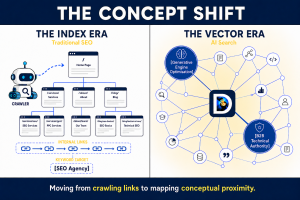
This is what makes a Human Moat AI search strategy fundamentally different from traditional SEO. Traditional SEO optimised for a ranked link. It was a competition of degree, where you tried to be marginally better than the page above you. A Human Moat AI search approach is a competition of kind.
You are not trying to be a better version of everyone else. You are trying to be the only source for something, so that the AI has no alternative but to cite you.
The selectivity is intensifying too. Analysis shows that ChatGPT retrieves many pages but cites only around 15% of them. That filter favours high-authority sources with independent validation. As the models get better at judging what to trust, generic content gets squeezed out and evidence-backed content gets pulled in.
This is the counterintuitive truth of the AI search era. The more content AI produces, the more valuable genuine human expertise becomes. Scarcity creates value, and in a world drowning in AI-generated average, proof is the scarcest thing there is.
There is a further signal worth noting. Audiences are developing an instinct for AI-generated content even when they cannot articulate why. They describe it as technically correct but emotionally absent. Accurate, but somehow hollow.
That same quality which makes readers disengage is the quality that makes AI systems hesitate to cite. Content without a human behind it reads as content without authority. Both people and machines are learning to tell the difference.
What this looks like in practice
This is not theory. Some of the most respected names in the industry have built their entire authority position on exactly this principle, whether they called it a Human Moat or not. Each of them, in their own way, has built a Human Moat AI search advantage long before the term existed.
Ahrefs is the clearest example. They consistently publish original research drawn from their own platform data, numbers that exist nowhere else because only Ahrefs can generate them. The result is that ChatGPT, Perplexity and Google AI Overviews reference Ahrefs research constantly. And the commercial payoff is remarkable.
Their own figures show that AI search traffic, just 0.5% of their total visitors, produced 12.1% of their signups over a 30-day window. Those visitors viewed 50% more pages per session with lower bounce rates than traditional organic traffic. The moat did not just earn citations. It earned customers.
Similarweb takes the same approach and adds a crucial refinement. They publish original research on a schedule, including their annual Generative AI Landscape and Brand Visibility Index reports, each built around numbers that did not exist before they published them.
A single report is a one-time citation spike. Running the same measurement repeatedly turns your domain into the default source for that number every time it updates. That is how a moat compounds over time rather than spiking once and fading.
Andy Crestodina at Orbit Media has done this for over a decade with his annual blogging survey. By committing to original research year after year, he has become one of the most cited voices in content marketing, not because he writes more than anyone else, but because he publishes data nobody else has.
His research has become the reference point an entire industry returns to, which is exactly what a Human Moat is designed to achieve.
And I will give you our own example, because I believe the strongest way to demonstrate a Human Moat is to build one in public.
At Digitalhound we developed a concept we call Citation Share, a way of measuring how often AI systems name your brand as the authoritative source for the queries that matter to your business. We did not read about Citation Share somewhere and repackage it. We built the methodology, applied it to client work and published the results.
Today the Digitalhound page for Citation Share ranks number 1 for that term, and we hold verified position 1 results above major aggregators for client work in competitive sectors, with AI Overview citations to match.
That is a Human Moat in action. The concept, the methodology, the verified proof and the interpretation are all things a language model cannot originate. It can only cite them. And increasingly, it does.
This very article is another brick in that same wall, an original framework published by the people who developed it, which is precisely the kind of asset AI search rewards.
How to build your own Human Moat
The good news is that you do not need a research department or a large budget to start. Every business already sits on material that AI cannot replicate. Most simply never publish it. Building a Human Moat content strategy is less about creating something new and more about surfacing what you already have.
It starts with 6 honest questions.
What do we know that nobody else knows? Every business accumulates knowledge through doing the work that is invisible to outsiders. The patterns, the shortcuts, the things that only become obvious after years in the field.
What data do we own? You almost certainly track something internally that nobody outside your company has ever published. A conversion rate segmented a particular way. A seasonal pattern. A benchmark from your own operations. That number, published with its source and method attached, is a citable asset the moment it goes live.
What have we measured? Businesses measure constantly and publish almost none of it. The measurement you already do is raw material for original content that cannot be copied.
What have we tested? Every experiment you have run, every A and B comparison, every approach you tried that worked or failed, is a documented outcome that exists nowhere else.
What have we learned? The lessons of genuine experience, written down honestly, are impossible for AI to fabricate because it was not there. It did not make the mistake. It did not live the consequence.
What can only we publish? This is the question that ties the others together. If the answer to what you are about to publish is anyone could write this, do not publish it. If the answer is only we could write this, you have found your moat.
Once you have the material, the structure matters as much as the substance. AI extracts most heavily from the top of a page. Research shows that 44.2% of all ChatGPT citations come from the first 30% of a page. So lead with the answer.
Front-load your strongest finding. Box your methodology so its origin is clear. Attribute your claims to a named expert with verifiable credentials. Structure the proof so a machine can lift it cleanly and a human can trust it immediately.
The formula, made practical, looks like this:

FAQS
Why is my content not being cited by AI even though it ranks on Google?
Ranking and being cited are two different outcomes driven by different signals. Google rankings reward relevance and domain authority. AI citations reward extractable, verifiable, original content that a model can trust as a source. If your content ranks but is not cited, it usually means it lacks a Human Moat: original data, verifiable proof or expert interpretation that AI cannot generate itself. The fix is not more optimisation. It is more evidence.
How do I get my business cited by ChatGPT and other AI tools?
Publish content that AI cannot originate. Lead with a direct answer in the first sentence, structure your proof so it is easy to extract, attribute claims to a named expert with verifiable credentials, and above all include original data or insight that exists nowhere else. Content built on original research is cited up to 10 times more often than generic content. That is the core of a Human Moat content strategy.
What kind of content does AI search actually reward?
Original research and proprietary data achieve a citation rate of between 38% and 65% in AI search, compared to 6% to 15% for standard blog posts. AI rewards content that is front-loaded with a clear answer, structured for easy extraction, backed by verifiable proof and attributed to a genuine expert. Generic content that summarises what already exists online is increasingly ignored, because an AI model can generate that itself.
Does original research really improve AI visibility?
Yes, measurably. When you publish a statistic or finding that exists nowhere else, an AI engine cannot source it from a competitor. It has to cite you, and keep citing you every time a related question is asked. This is why businesses that publish original data become default sources in their sector. It is the single most reliable way to build durable AI search visibility.
Is SEO still worth it in the age of AI search?
Yes. SEO is the foundation a Human Moat AI search strategy is built on. Pages with strong traditional SEO signals are cited by AI tools far more often than pages without them. The mistake is treating SEO as the whole strategy. You need strong SEO to be discoverable and a Human Moat to be citable. They are connected disciplines, not competing ones.
What is the difference between Citation Share and a Human Moat?
Citation Share measures whether AI systems are citing your business. It is the diagnostic that tells you where you stand. A Human Moat explains why they should cite you. It is the strategy that changes where you stand. One measures the outcome, the other builds the cause. Used together, they turn AI visibility from something that happens to your business into something you control.
Citation Share and the Human Moat are two halves of the same idea
There is a reason these 2 concepts belong together.
Citation Share measures whether AI systems are citing your business. It is the diagnostic. It tells you, objectively, whether you are present in the answers your customers are seeing.
The Human Moat explains why they should. It is the strategy. It is the reason a language model would choose your brand over the dozens of interchangeable alternatives.
One measures the outcome. The other builds the cause. Track your Citation Share and you will know where you stand. Build your Human Moat and you will change where you stand.
A Human Moat content strategy gives you both the map and the means. Used together, they turn AI visibility from something that happens to your business into something you actively control.
This is the shift I believe every serious business needs to make. Not more content. Not faster content. Not cheaper content. The web already has an infinite supply of all three.
What it does not have, and never will have enough of, is proof. Original insight. Genuine expertise, documented and published by the people who actually earned it.
AI can replicate average at infinite scale and zero cost. It cannot replicate what you know, what you have done and what you can prove. That gap is not closing. As the models get more selective, it is widening.
The businesses that understand this now, and start building their Human Moat while their competitors are still churning out AI-generated filler, will hold a position that becomes harder to challenge. That same original content is also the foundation for Google Preferred Sources, the mechanism that converts loyal readers into a permanent, individual-level search visibility advantage. with every passing month. A Human Moat AI search strategy is not a campaign you run once.
It is an advantage that compounds every time you publish something only you could have published.
The window is open. It will not stay open forever.
If you want to understand where your business currently stands in AI search, and whether the content you are publishing is building a moat or adding to the noise, that is exactly the work we do.
Start with a conversation about your Citation Share, and we will show you precisely where your Human Moat already exists and where it needs building.


Digitalhound's work spans technical SEO, AI-assisted content strategy, conversion optimisation and brand authority. The agency's content has achieved first page Google rankings against globally recognised publishers including Search Engine Land, TripAdvisor and Saga Holidays.
Darryl is a sought-after speaker at digital marketing conferences and has worked with clients ranging from independent law firms to FTSE-listed businesses. He writes on the intersection of AI, search strategy and commercial communication.
Digitalhound | 207 Regent Street, London W1B 3HH | digitalhound.co.uk | content@digitalhound.co.uk | 020 7873 2476