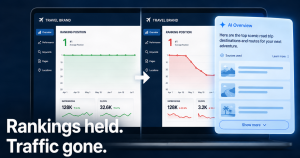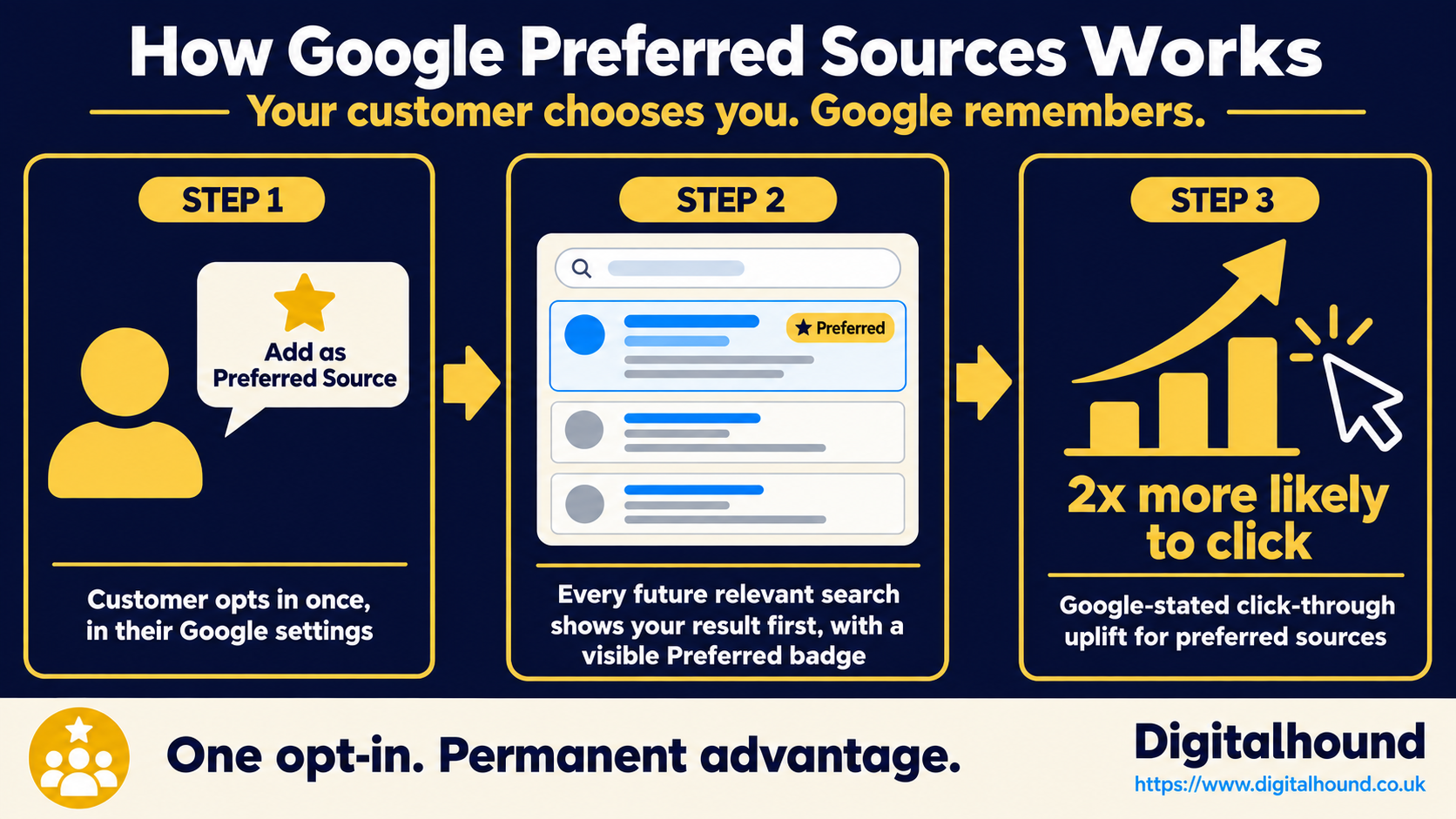
Google Preferred Sources is a Google Search feature that lets your customers choose your website as a trusted source, so that when they search for anything you cover, Google shows them your content first inside AI Overviews, AI Mode and Top Stories, marked with a visible Preferred badge. It runs outside the standard ranking algorithm: no amount of SEO spend, ad budget or domain authority can give a competitor that individual reader’s slot once they have chosen you.
Table of Contents
Google Preferred Sources is one of the most significant changes to how customers find businesses online in the past decade, and most business owners have never heard of it. That gap will not last long. This guide explains what it is, what it means for your company and your customers, and exactly what to do about it before your competitors do.
What is Google Preferred Sources and how does it work?
Let me explain this as simply as I can, because most of the coverage I have read online makes it more complicated than it needs to be.
A customer of yours opens their Google account settings. They search for your website and they mark it as a preferred source. That takes about 10 seconds and requires one click. From that moment, Google treats your website differently for that customer.
Whenever they search for something you cover, Google will surface your content first, inside their AI Overview, inside AI Mode, and in their Top Stories feed. Your result gets a visible “Preferred” label so they can spot it instantly.
That is it. No algorithm to game. No technical work required on your website. No application process and no approval. The signal lives entirely in your customer’s Google account, not on your website. The only technical requirement is that your website publishes fresh content. Any active business website qualifies.
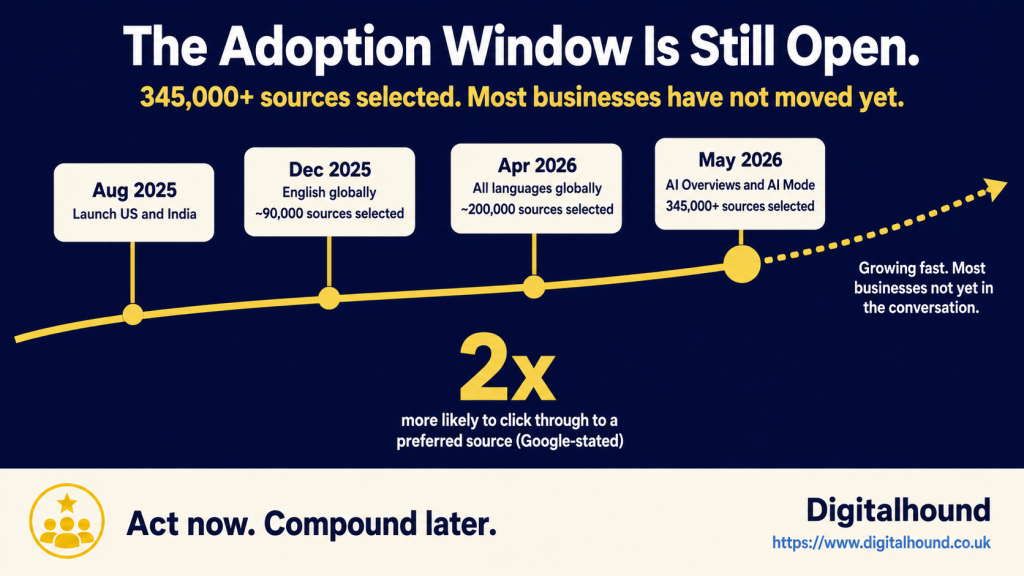
Google launched the feature in the United States and India in August 2025, expanded it to all English-speaking users globally in December 2025, and rolled it out across every supported language on 30 April 2026.
The development that changes the strategic picture came on 27 May 2026, when Google Preferred Sources was extended from Top Stories into AI Overviews and AI Mode.
That extension, announced by Google’s own product team, is the one that makes this a serious business issue rather than a minor personalisation feature.
Google has reported that users are roughly twice as likely to click through to a source they have marked as preferred compared to a standard result at the same position. More than 345,000 unique sources had already been selected worldwide by the time of that announcement in May. These are not trial numbers. People are actively using this.
What does this mean for my customers?
Think about what your customer experiences when they search for something relevant to your business.
Before Google Preferred Sources moved into AI Overviews, they would type a query and receive a synthesised AI answer drawing on whichever sources Google’s algorithm chose to trust.
Your business might appear in that answer or it might not, and there was no reliable way to influence which outcome the algorithm chose for any given customer.
After a customer marks you as a preferred source, that changes completely. When they run any query your content is relevant to, your result appears with a Preferred badge that stands out immediately from everything around it. They are twice as likely to click.
The relationship between your customer and your business now has a direct line into Google’s AI surfaces that your competitors cannot intercept, regardless of how much bigger they are or how much more they spend on advertising.
The important nuance, and it is worth being honest about this because some coverage glosses over it, is that this only works for customers who have already chosen you. Google Preferred Sources does not help you find new customers through search.
What it does is make you permanently visible to the customers who already value what you do. That is a genuinely different thing from SEO, and it is commercially significant for a different reason. Once a loyal customer has chosen you, you have won their next search, and the one after that, without having to compete for it again.
Think of it this way. Every time a loyal customer of yours runs a Google search on a topic you cover, your result is the one that appears with the Preferred badge. Not a competitor’s. Not a larger brand’s. Yours.
That is the customer experience Google Preferred Sources creates, and it is entirely driven by the relationship you have already built, not by your ad budget or your domain authority.
What does this mean for my business?
This is the question that matters most and the one most coverage fails to answer properly.
What Google Preferred Sources does, at its commercial core, is convert your most loyal customers into a permanent, algorithm-proof visibility advantage. A customer who has marked your website as preferred is a customer no competitor can out-rank for that individual’s next relevant search.
It does not matter how big the competitor is. It does not matter how much they spend on Google Ads. It does not matter how many backlinks they have or what their domain authority score looks like. The contest for that customer has been removed from the algorithm’s hands and placed in the customer’s. You have already won it.
For businesses that compete against large platforms, aggregators or dominant brands in their sector, that is a significant shift. I work with travel brands, law firms and ecommerce businesses who spend significant time and money trying to out-rank Booking.com, major legal directories or Amazon in standard search results.
That is a contest the algorithm is, in many cases, designed for them to lose. Google Preferred Sources changes the terms of the contest entirely for the customers who matter most: the ones who already know you and trust you.
The adoption numbers are also worth understanding. More than 345,000 sources had been selected globally by May 2026. That sounds like a large number, but relative to the billions of Google users and the millions of businesses competing for their attention, it means the overwhelming majority of your customers have not yet selected any preferred source at all.
The window to be the brand they choose first, before competitors are even asking the question, is still open. It will not stay that way.
There is another commercial dimension worth spelling out. Customer acquisition is expensive. The customers who already buy from you, book with you or instruct you are worth more than any new lead precisely because the trust has already been established.
Google Preferred Sources is, in effect, a way of protecting that investment. Every customer who marks you as a preferred source is a customer whose next relevant search you have already won, at zero additional cost. That compounds over time.
A business with 500 loyal customers who have opted in has a permanent, individual-level visibility advantage across 500 separate Google accounts that no competitor can buy their way into.
For any business where repeat customers or long-term relationships are the commercial foundation, this mechanism is not a nice-to-have. It is the most direct way available to protect your visibility with the people who already matter to your revenue.
Google Preferred Sources in practice: what this looks like across different sectors
The mechanism is the same regardless of what your business does. But the specific advantage it creates varies by sector, and it is worth seeing it through the lens of your own industry before deciding how to act on it.
Travel and hospitality. An independent hotel or boutique tour operator is, in most cases, competing against Booking.com, Expedia and TripAdvisor for visibility in Google search. Those platforms have domain authority, review volume and advertising budgets that most independent properties cannot match.
Google Preferred Sources changes the terms of that competition for the guests who already know you. A returning guest who has marked your hotel as a preferred source will see your result with a Preferred badge the next time they search for accommodation in your destination. The platform with the bigger ad budget cannot buy that slot. The relationship with the returning guest has already secured it.
Legal services. A solicitor or law firm competing against legal directories like Legal 500 or directories with thousands of firm listings faces a similar visibility challenge in standard search.
For a client who has used the firm before, or who has read and valued its content, marking the firm as a preferred source means the next time they search for legal guidance on a relevant topic, the firm appears first.
In a sector where trust is the primary driver of instruction, converting existing client relationships into a permanent AI search presence is a direct commercial advantage.
Ecommerce. An independent ecommerce brand competing against Amazon or large aggregators in product searches faces an algorithm that, in most cases, favours scale. Preferred Sources does not change that for cold searches by new customers.
But for customers who have bought from you before and trust you, it means your next new product, your next guide, your next recommendation appears first when they search for something in your category.
In ecommerce, repeat customers are significantly more valuable than new ones. Google Preferred Sources is a way of protecting and deepening that relationship at the search level.
Professional services and B2B. A consultancy, agency or specialist services business often builds its client base through content, thought leadership and reputation rather than advertising. Clients who follow your thinking and read your output are exactly the audience most likely to opt in as a preferred source.
When they are next searching for advice, analysis or a service provider in your space, your content appears first. For B2B businesses where the buying cycle is long and trust is built over multiple touchpoints, that sustained presence inside a client’s search experience is a compounding advantage that reinforces the relationship each time they search.
Is this already affecting my search rankings?
This is where I want to be precise, because a number of sources are overstating what Preferred Sources currently does and I think business owners deserve an honest answer.
As of now, Google Preferred Sources affects individual-user visibility, not general rankings. When a customer who has selected you as preferred runs a relevant search, your content is prioritised and labelled for them specifically. Your organic position in standard search results for other users is not directly changed by it.
Google has stated that it intends to weight Preferred Sources selections more heavily over time, as a broader signal in how it ranks and surfaces content. That announced intention has not yet been implemented as a live general ranking factor.
What exists today is individual prioritisation for users who have actively chosen you, which is already commercially valuable, but it is not the same thing as a ranking boost across the board.
I mention this not to play it down but because understanding exactly what a tool does is the only way to use it properly. The value of Google Preferred Sources right now is the direct, permanent visibility it creates with the customers who already trust you. That value is real and it is worth building on purpose.
What is the Highly Cited badge and why does it matter alongside Preferred Sources?
On the same day Google extended Preferred Sources into AI Overviews in May 2026, it launched a companion feature called the Highly Cited badge.
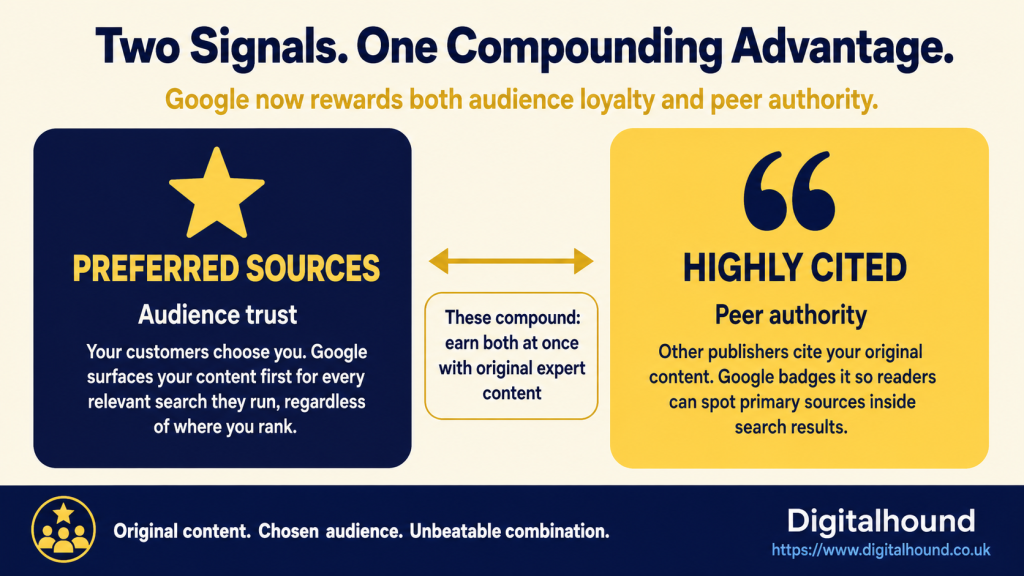
The badge labels articles that other publishers have explicitly cited as original sources. Where Preferred Sources earns you audience trust, the Highly Cited badge earns you peer authority. Google’s AI surfaces are now making a visible quality judgement between content that simply covers a topic and content that other credible sources have trusted enough to reference directly.
The strategic connection between the two is worth understanding. A business that produces original research, genuine expert insight, first-hand experience or proprietary data is the kind of business that earns citations from other sources.
That same originality is the reason a customer marks it as preferred in the first place. The content that earns the Highly Cited badge and the content that earns Preferred Sources opt-ins are, in most cases, the same content. Building both advantages at once is not twice the work. It is the same work producing two compounding results simultaneously.
This is why we connect Google Preferred Sources to the broader content strategy we call the Human Moat content strategy: the discipline of producing content that AI systems are structurally obliged to cite rather than replace, because it contains original expertise, verifiable proof and genuine human insight that no algorithm can synthesise from existing sources.
Is my business eligible for Google Preferred Sources?
Almost certainly yes, and the eligibility rules are simpler than most guides suggest.
Google’s stated requirement is that your website publishes fresh, relevant content. Any active business website that publishes content regularly qualifies. There is no application, no approval process and no minimum size requirement.
One eligibility point that is frequently misreported and worth knowing clearly: Google preferred sources operates at domain and subdomain level. A standalone domain qualifies. A subdirectory does not. If your content sits at yourbusiness.com it qualifies.
If it sits at largerplatform.com/your-blog it does not, because the preferred source selection applies to the whole domain, not a section of it. This is confirmed in Google’s own Search Central documentation.
The deep link that allows customers to add your site with a single click goes to google.com/preferences/source followed by your domain name. Google also provides downloadable button assets in multiple languages that you can place on your website to make the opt-in visible. There is no technical implementation required beyond placing that link where your customers will see it.
How do I get my customers to mark me as a preferred source?
This is where the strategy moves from understanding to doing, and it is simpler than it might look.
The customers most likely to mark you as preferred are the ones who already value what you do. Your existing audience, past customers, newsletter subscribers and regular readers are the foundation of your Google Preferred Sources strategy. They already trust you. You simply need to make the opt-in easy to find and ask for it at the right moment.
The right moment is almost always when goodwill is at its highest. Just after a customer has had a great experience with your business, just after they have read a piece of your content that genuinely helped them, just after they have completed a purchase or a booking: these are the moments when the ask lands most naturally and most effectively.
Place the opt-in link in your booking confirmation emails, in your post-purchase follow-ups, in your newsletter, on your most-read content pages. The one-click deep link means the friction is minimal.
A direct sentence asking your audience to choose you as a preferred source, explained honestly as a way to make sure they always see your content when they search, is far more effective than a passive button buried in a footer.
The phrasing of the ask matters. “Enjoyed this guide? Add us as a Preferred Source on Google and we will always appear first when you search for topics we cover” is cleaner and more honest than a vague call to action.
People respond to transparency about what they are doing and why it benefits them. Google’s own interface makes it easy: the deep link opens a pre-filled preferences page where a single click adds your domain.
It is also worth thinking about volume and timing together. A business that asks 100 of its most loyal customers to opt in during a post-purchase email sequence will build its Preferred Sources audience faster than one that quietly places a button on its homepage and waits. Active, direct, well-timed requests work. Passive placement does not.
There is an important measurement challenge worth flagging. Google does not provide a dashboard showing how many users have selected your site as a preferred source.
The signals to watch instead are: clicks on your opt-in deep link if you are tracking it with UTM parameters, growth in branded search impressions in Google Search Console, and an increase in return visit frequency in your analytics.
None of these is a direct measure, but together they give you a directional picture of whether your Preferred Sources audience is growing.
How does this fit with everything else I’m doing for AI search?
Google Preferred Sources is one piece of a larger AI search visibility picture.
At Digitalhound we think about this in terms of three connected questions. The first is whether AI systems are naming your business at all when they answer relevant queries: this is what we measure through Citation Share, the metric that tracks how often AI search cites your business as an authoritative source.
The second is why AI should cite your business rather than a competitor, which is the content question: original data, verifiable expertise, first-hand experience and named human insight are the ingredients AI systems are most likely to reference rather than replace.
The third is how to make that earned authority permanently visible to the customers who matter most, which is where Google Preferred Sources comes in.
The sequence matters. There is no point building a Preferred Sources audience around content that gives people no reason to trust you in the first place. And there is no point producing excellent original content if you are not actively converting the loyal audience it builds into a permanent, individual-level visibility advantage in AI search.
If you want to understand how these three questions apply to your specific business, you will find the full frameworks in our pieces on Citation Share, the Human Moat content strategy – why original research earns AI citations, and the Audience Moat for independent travel brands.
The Google Preferred Sources guide you are reading now is the piece that connects them.
The window is currently open but it will not stay that way
I have been watching how quickly this feature is moving since it launched in August 2025.
The adoption curve from 90,000 selected sources in December 2025 to 345,000 by May 2026 tells you this is not a feature Google is quietly retiring. It is growing, and the businesses that build a Preferred Sources audience now, while most of their competitors have not asked the question yet, are building a compounding advantage.
Every customer who has chosen you is a customer whose next relevant search you have already won. That advantage does not diminish over time. It grows as you ask more customers to opt in.
The strategic moment is now, not because of panic, but because being early in AI search has historically been a structural advantage rather than a marginal one.
The businesses that were early to understand AI Overviews, early to build original content that AI systems could cite, and early to measure Citation Share rather than just rankings, are the ones that are visibly ahead today. Google Preferred Sources is the next mechanism in that progression.
The ones who understand it first will not just appear in AI search. They will be remembered by it, customer by customer, for every search those customers run from here.
The competitive picture is also shifting fast. As more businesses discover Preferred Sources and start running active opt-in campaigns, the relative advantage of moving early will compress. Right now, most businesses have not moved.
The customers of any business that asks first are the ones most likely to opt in, because they have never been asked before. That first-mover window is measurable in months, not years.
Digitalhound specialises in AI search visibility for businesses that want to be found, cited and chosen. To find out where your business stands in AI search right now and how to build your Preferred Sources audience before competitors do, speak to the Digitalhound team today.
★ Enjoyed this guide? Make Digitalhound one of your Preferred Sources on Google.


Digitalhound's work spans technical SEO, AI-assisted content strategy, conversion optimisation and brand authority. The agency's content has achieved first page Google rankings against globally recognised publishers including Search Engine Land, TripAdvisor and Saga Holidays.
Darryl is a sought-after speaker at digital marketing conferences and has worked with clients ranging from independent law firms to FTSE-listed businesses. He writes on the intersection of AI, search strategy and commercial communication.
Digitalhound | 207 Regent Street, London W1B 3HH | digitalhound.co.uk | content@digitalhound.co.uk | 020 7873 2476