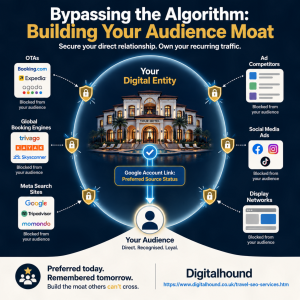
The Audience Moat is a travel brand’s compounding, individual-level search visibility advantage, built by converting loyal travellers into Google Preferred Sources so the brand is prioritised inside their AI Overviews and AI Mode answers regardless of standard rankings. Because a preferred source is chosen by the user and persists until they remove it, the Audience Moat gives independent hotels and tour operators a permanent, algorithm-proof discovery channel that global aggregators cannot out-rank or out-spend.
Table of Contents
The Audience Moat is the most significant shift in travel search visibility since AI Overviews arrived, and almost nobody in travel is using it yet. For two years the industry has asked one question in slightly different words: how do we stay visible when an AI Overview answers the query before anyone reaches our site?
That is the right question, but it is no longer the only one that matters. There is a second question now. Not how do we get cited, but how do we get chosen. Chosen once, by a real traveller, and then remembered by Google for every relevant search that person runs afterwards.
That is what the Audience Moat describes, and this article sets out what it is, why it exists, how it connects to the wider frameworks shaping modern travel SEO, and exactly what an independent travel brand should do about it now.
The problem the Audience Moat solves
The pressure travel brands are under is best understood through honest numbers rather than alarming ones.
Zero-click search is now the default state of Google. Independent clickstream analysis from SparkToro, reported by Search Engine Land, found that US Google searches ended without a click 68% of the time in early 2026, up from around 60% two years earlier.
AI Overviews now appear on more than one in five searches, and when they do, click-through rates fall by nearly 60%. The open web now receives roughly 276 clicks for every 1,000 searches, down from 374 two years ago.
Travel is not the worst hit sector, and it is important to say so. Because travel retains strong transactional intent, people still click through to book, to compare, and to read reviews before committing money.
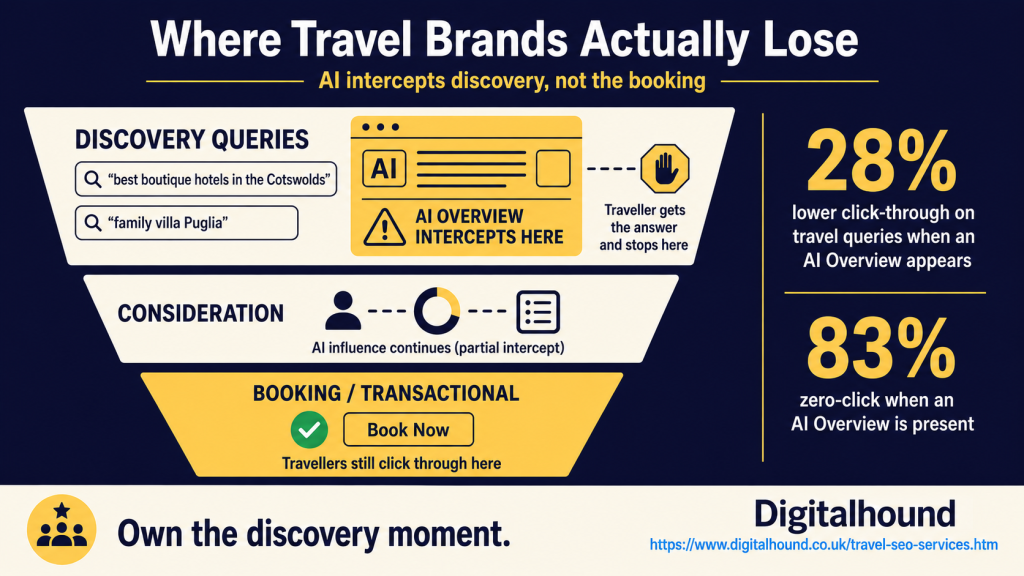
Branded, local and transactional queries continue to generate clicks even in a high zero-click environment, while informational and how-to queries are the ones AI Overviews most readily absorb. That distinction is the whole story for travel brands.
The queries where travellers still click are the bottom of the funnel, the ones where they already know the brand they want. The queries the AI Overview now intercepts are the discovery queries. “Best boutique hotels in the Cotswolds.” “Family-friendly villa Puglia.” “Where to stay near Carcassonne.”
These are precisely the searches through which an independent travel brand used to be discovered by someone who had never heard of it. That top-of-funnel discovery layer is the part AI Overviews have quietly absorbed. A traveller reads three synthesised recommendations, taps through to one, and the other two never existed as far as that trip is concerned.
So the strategic problem is not that travel brands lose all their clicks. It is that they lose the discovery moment, the single most valuable moment in the travel research journey, to whichever handful of brands the AI names.
For most independent operators that is a contest they cannot win on the AI’s terms, because those terms reward scale, domain authority, and the aggregated review volume that OTAs and global booking engines have spent a decade accumulating.
The Audience Moat answers the question that follows directly from this. If an independent brand cannot reliably out-rank Booking.com and Expedia inside a generic AI Overview, can it make itself the brand the AI names anyway, for the travellers who actually matter to it? As of 2026, the answer is yes, because Google itself has built the mechanism.
Preferred Source: the mechanism behind the moat
On 27 May 2026, Google announced that its Preferred Sources feature was extending into AI Overviews and AI Mode. The feature was not new. It had launched in Top Stories in the United States and India in August 2025 and gone global across all supported languages by April 2026, but until late May it only shaped the Top Stories news carousel.
The May announcement is the one that changes travel SEO, because it extended the mechanism into the AI answer surfaces where discovery now happens.
The way it works rewards slow reading, because the implications are larger than they first appear.
A Google user opens their Search personalisation settings, or taps the star icon beside Top Stories, and marks a website as a preferred source. From that point, whenever that site publishes content relevant to something the user searches, Google prioritises it for that individual.
Inside their AI Overviews, inside their AI Mode answers, inside Top Stories, that site’s link appears with a visible “Preferred” badge.
Google has reported that users are roughly twice as likely to click through to a source they have marked as preferred, and that more than 345,000 unique sources had already been selected worldwide by the time of the announcement.
Read those two numbers together and the picture is clear. This is not a dormant setting nobody touches. Hundreds of thousands of people are actively curating the brands they want Google to prioritise for them, and the brands they pick gain a durable advantage inside the exact surfaces eating everyone else’s discovery traffic.
Four features of this mechanism make it different from everything else in the SEO toolkit, and they are why it deserves a strategic framework of its own rather than a paragraph in a general AI search guide.
First, it is a user-controlled signal, which is rare. There is no algorithm on the website side to optimise, reverse-engineer, or game. Either the traveller adds the site or they do not.
Second, it overrides standard rankings for that individual. For a user who has marked a site as preferred, its relevant content is prioritised regardless of where it sits in the standard global rankings for that query.
A boutique hotel that would never out-rank an OTA in a generic search can appear first inside the AI answer for every traveller who has chosen it.
Third, there is nothing to implement on the page. No schema, no markup, no technical work. The signal lives entirely in the reader’s Google account. The only lever a brand has is making it as easy as possible for a traveller to opt in, which Google supports with an official deep link and button.
Fourth, and this is the point the industry has not yet absorbed, it is permanent until the user removes it. A standard ranking is contested afresh on every query by every competitor with a bigger budget and a bigger backlink profile. A preferred source relationship, once established, simply persists.
What the Audience Moat is
Preferred Source is the mechanism. The Audience Moat is the strategy for using it deliberately. For a complete guide to how Google Preferred Sources works and what your business should do about it, we have covered it in full.
The Audience Moat is the compounding, individual-level visibility advantage a brand builds when it converts genuine audience relationships into Preferred Source status at scale. It is the discipline of turning people who already trust a brand into a permanent, algorithm-proof distribution layer inside AI search.
The metaphor is deliberate. A moat is not a weapon. It does not help a brand attack a competitor’s position. It makes its own position impossible to attack. That is exactly the property Preferred Source confers.
A traveller who has marked a hotel as a preferred source is a traveller no OTA can out-bid, no aggregator can out-rank, and no competitor can out-spend, because the contest has been removed from the algorithm’s hands and placed in the traveller’s. The brand is not fighting for that person’s next search. It has already won it, and keeps winning it until the traveller decides otherwise.
For an independent travel brand this is close to revolutionary. A single boutique property in Cornwall can establish, for its own audience, the same search dominance Booking.com enjoys across the whole market.
Not through ad spend. Not through domain authority. Through relationship equity, converted into a signal Google now honours above its own rankings.
How the Audience Moat fits the wider framework
Modern travel SEO now rests on three connected ideas, and the Audience Moat is the one that makes the other two pay off. Setting them side by side is useful, because each answers a different question and together they describe the whole modern visibility problem.
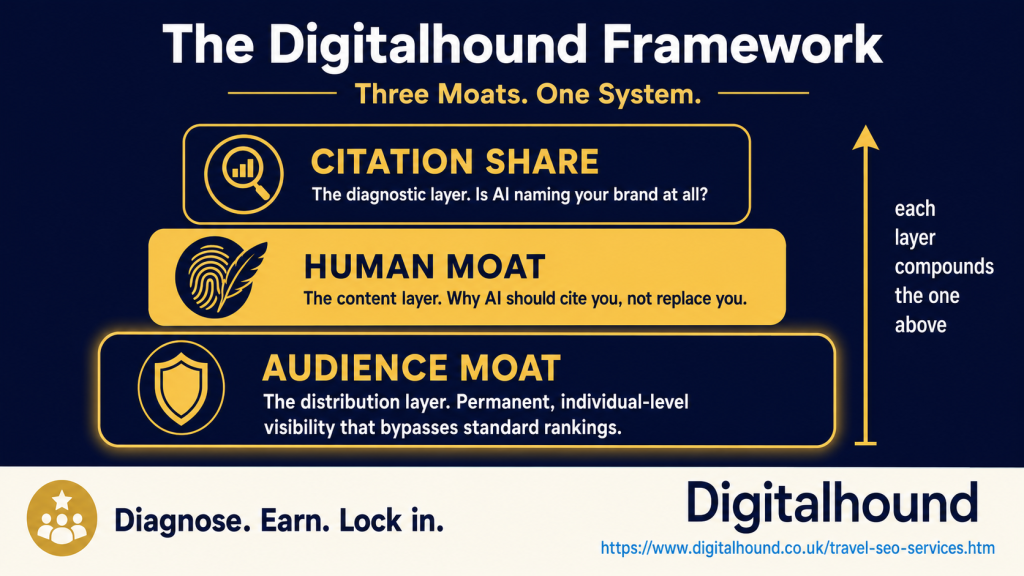
Citation Share measures whether AI systems name a brand at all. It is the diagnostic layer. It asks whether, when a traveller poses a question a brand should be able to answer, the AI cites that brand as an authority or cites someone else. It is how the problem is quantified before it is solved.
The Human Moat explains why an AI should cite one brand rather than a competitor. It is the content layer. AI systems can synthesise and rephrase almost anything, but they cannot originate original data, real lived experience, verifiable proof, or genuine expert interpretation.
They can only cite the humans who produced those things. The Human Moat is the strategy for producing content AI is structurally obliged to reference rather than replace.
The Audience Moat converts that earned authority into permanent, individual-level dominance. It is the distribution layer. Citation Share tells a brand whether AI names it. The Human Moat gives AI a reason to.
The Audience Moat locks in a visibility advantage that bypasses the standard ranking contest altogether, for every traveller who has chosen the brand.
The sequence matters. A brand with no original authority has nothing worth marking as a preferred source, because its content is exactly the derivative material AI is happy to summarise and discard.
A brand with strong original content but no Audience Moat strategy earns citations it never converts into durable relationships, and stays at the mercy of a ranking contest it may lose tomorrow. The two moats compound. Original authority earns the trust.
The Audience Moat makes that trust permanent inside the surfaces that now decide who gets discovered. This is the logic behind the wider approach to travel SEO in the AI era.
Why this favours the independent operator
There is a genuinely optimistic conclusion here, and it runs against the grain of almost everything else written about AI search.
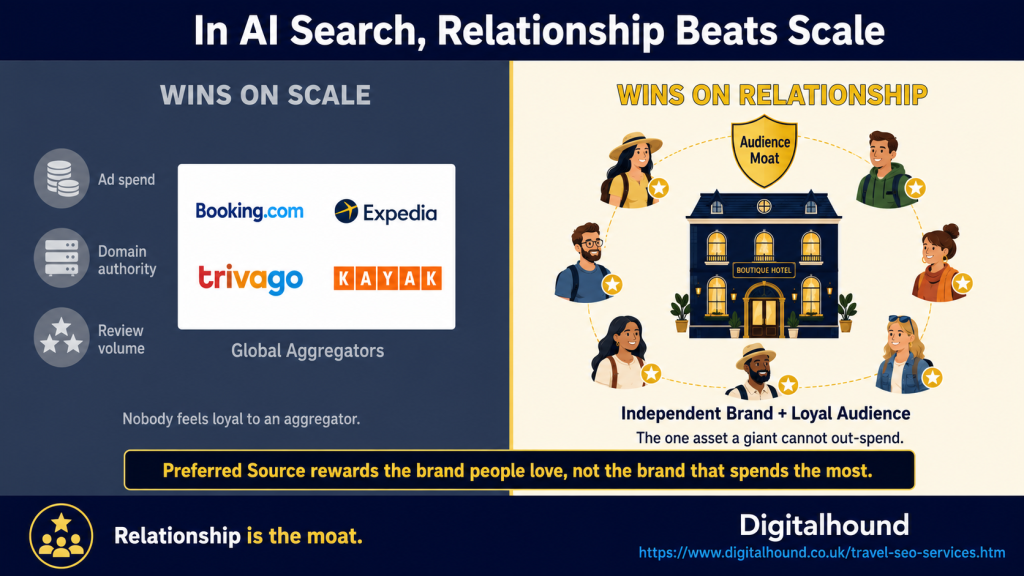
For two years the story has been that AI search punishes small brands and rewards scale. In the standard ranking contest that is broadly true. AI Overviews lean on domain authority, aggregated reviews, and citation volume, all of which favour the OTAs and global booking engines.
An independent hotel trying to out-rank Booking.com inside a generic AI Overview is fighting a battle the mechanism is designed for it to lose.
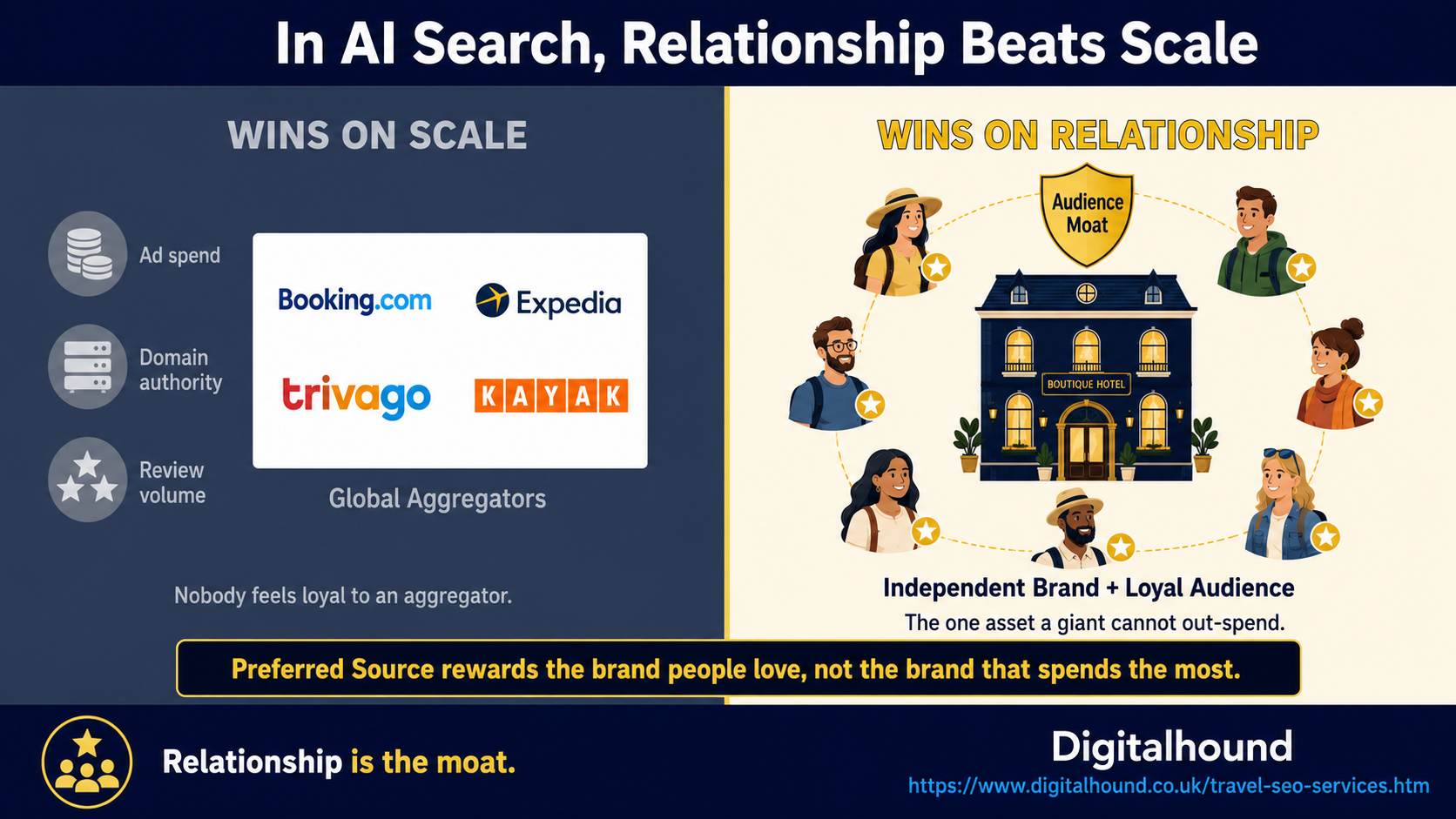
Preferred Source inverts that logic. Where the standard contest rewards scale, the Audience Moat rewards relationship. And relationship is the one thing an independent travel brand almost always has more of than a global aggregator.
Nobody feels personally loyal to Expedia. People feel loyal to the small hotel that remembered their anniversary, the tour operator who rescued their itinerary when a flight was cancelled, the villa company whose owner answered the phone late at night.
That emotional equity has always existed. What has never existed until now is a way to convert it directly into search visibility that Google honours above its own rankings. Preferred Source is that conversion mechanism, and the Audience Moat is the discipline of using it on purpose.
The independent operator’s structural disadvantage in AI search, a lack of scale, is irrelevant to Preferred Source. The independent operator’s structural advantage, genuine human relationships, is the entire currency of it.
For the first time in the AI era, the mechanism favours the brand people actually love rather than the brand that spends the most.
What to do about it now
A framework that stays theoretical is worthless, so here is the practical path. Each step feeds the next.
Confirm eligibility first, which is almost certainly already met. Google’s stated requirement is simply that a site publishes fresh content. Any active travel brand publishing regularly qualifies. There is no application and no approval.
Build original authority before anything else, because it is the reason anyone would ever mark a brand as preferred. A traveller does not opt in to a brand whose content they could get anywhere. They opt in to the brand whose destination guides, original insight, and genuine on-the-ground expertise they cannot find elsewhere.
Make the opt-in effortless. Google provides an official “add as a preferred source” deep link and button. Place it where the most engaged travellers already are: in booking confirmation emails, in post-stay follow-ups, in the newsletter, on the best-performing destination guides. The moment of highest goodwill, just after a traveller has had a wonderful experience, is the moment to ask.
Ask the people who already care. The Audience Moat is built one relationship at a time, and existing guests, subscribers and repeat bookers are the foundation. A brand with 2,000 genuinely loyal past guests who mark it as preferred has, for those travellers and everyone with a similar search profile, a visibility advantage no competitor can dislodge.
Then measure the compounding effect, so the moat can be seen deepening rather than guessed at.
None of this requires a bigger budget than a competitor. It requires a better relationship with an audience than a competitor, and that is a contest independent travel brands are built to win.
The window is open now
Preferred Source moved into AI Overviews in late May 2026. The overwhelming majority of travel brands, including large ones with substantial marketing teams, have not yet registered what it means.
They are still fighting the old contest, still trying to out-rank aggregators inside generic AI Overviews, still treating AI search as a problem to survive rather than a mechanism to exploit.
That gap is the opportunity, and it will not stay open. The brands that build their Audience Moat now, while competitors are still asking how to get cited, will hold a compounding, individual-level visibility advantage that later entrants cannot easily undo, because a preferred source relationship, once established, persists until the traveller removes it.
This is one of the rare moments in search where being early is not a marginal advantage but a structural one.
The travel brands that understand this first will not just appear in AI search. They will be remembered by it, traveller by traveller, for every trip those travellers plan from here.
Preferred today. Remembered tomorrow.
Digitalhound is a London SEO agency specialising in AI search visibility for travel brands. To understand where your travel brand stands in AI search now, and how to build your Audience Moat before competitors do explore our, travel SEO services.
★ Enjoyed this guide? Make Digitalhound one of your Preferred Sources on Google.


Digitalhound's work spans technical SEO, AI-assisted content strategy, conversion optimisation and brand authority. The agency's content has achieved first page Google rankings against globally recognised publishers including Search Engine Land, TripAdvisor and Saga Holidays.
Darryl is a sought-after speaker at digital marketing conferences and has worked with clients ranging from independent law firms to FTSE-listed businesses. He writes on the intersection of AI, search strategy and commercial communication.
Digitalhound | 207 Regent Street, London W1B 3HH | digitalhound.co.uk | content@digitalhound.co.uk | 020 7873 2476