There is a running joke in travel marketing circles that Gen Z will happily look at a completely empty bank account, open up the group chat, and book a flight to Ibiza anyway. We laugh because it is true.
The “YOLO” mindset is alive and well, and younger consumers are actively sacrificing daily luxuries like dining out or clothes shopping just to make sure they can get away.
But if you look at how many travel and hospitality operators treat this generation, you would think they were a passing fad. Far too many brands view Gen Z as a low-margin hassle.
They see a demographic that hunts for cheap flights on Ryanair, splits vacation rental costs ten ways, and stays in budget accommodation. The consensus seems to be that they are not worth premium marketing spend because their immediate order value is too low.
This is a massive, short-sighted mistake.
When you look past the immediate transactional value of a single weekend break and start calculating long-term lifetime value (LTV), the data tells a completely different story. Gen Z is not just a quirky trend.
They are the single most important loyalty play for travel and tour operators over the next three decades. To win them over, the industry must fundamentally change how it maps the booking journey, shifting away from fragmented website redirects and leaning heavily into the friction-free world of social commerce in travel.
Table of Contents
The Macroeconomics of the Youth Travel Market
To understand the scale of the commercial opportunity, we first need to dismantle the pervasive industry myth that Gen Z has no money to spend. Because many entry-level salaries in the UK look modest on paper, traditional travel marketing suites frequently ignore this cohort in favour of wealthier Gen X or Boomer demographics.
This approach relies on an outdated understanding of personal finance and consumer prioritisation.
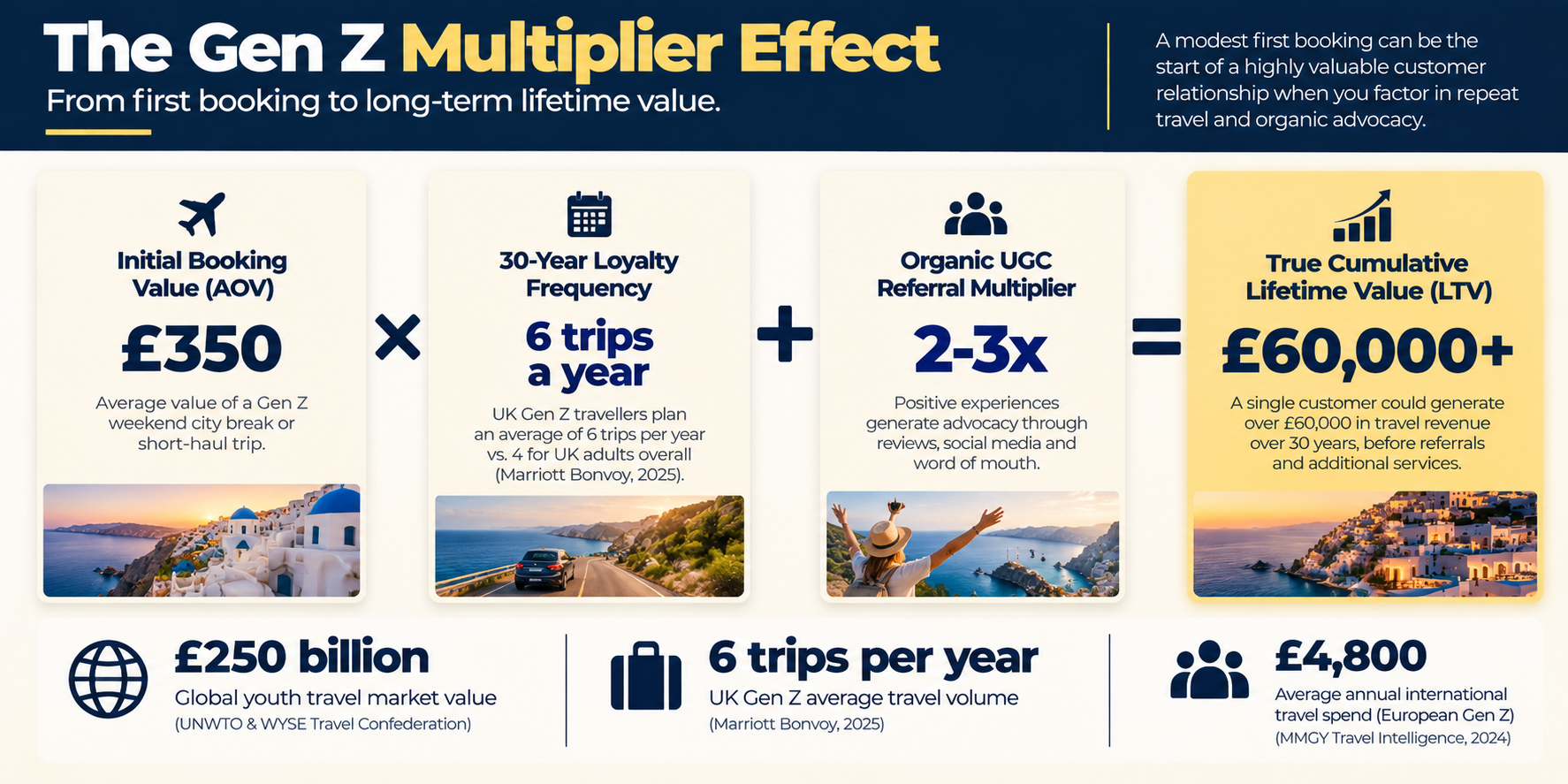
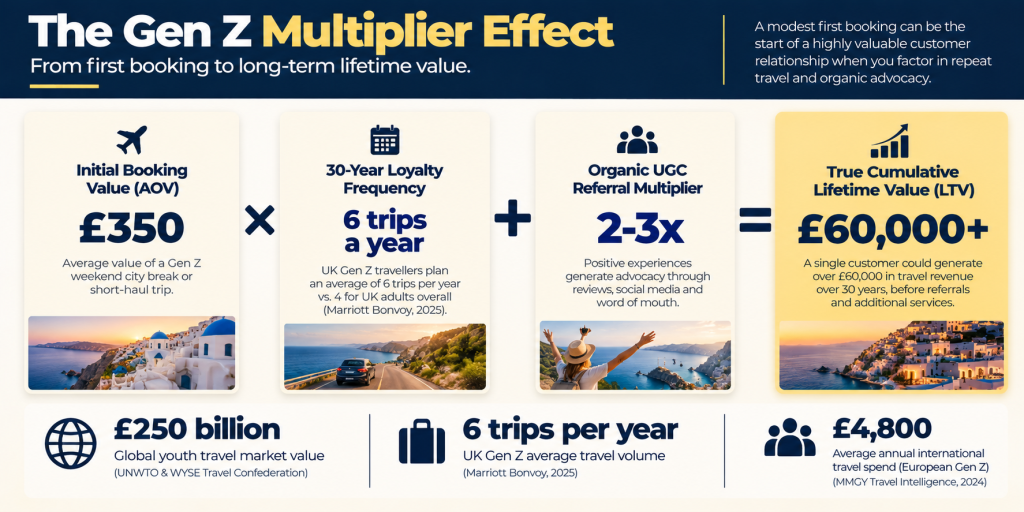
While it is true that the majority of Gen Z travel on strict budgets, a highly lucrative segment of ultra-high spenders is rapidly emerging. Joint data from global youth travel networks and macroeconomic tracking groups places the wider youth market at an astonishing €250 billion in annual expenditure.
Active UK and European Gen Z travellers are leading the charge, spending an average of £4,800 annually on international trips.
What is even more striking to hospitality operators is the sheer volume of their movement. According to research by Marriott Bonvoy, UK Gen Z travellers are taking an average of six trips per year, inclusive of short domestic breaks and outbound international holidays. This easily eclipses the UK national average of just four trips per year across older demographics.
The financial reality is not that Gen Z lacks capital; it is that they distribute it with fierce intentionality. They are currently living through a unique economic window. Facing a highly challenging UK housing market, many young adults are delaying traditional milestones like homeownership or starting a family.
Instead of saving for a mortgage deposit that feels completely out of reach, they are choosing to reallocate their disposable income into the experience economy. Travel is no longer viewed as an annual luxury or an occasional treat. It has become a non-negotiable component of their personal identity and mental well-being.
Furthermore, we are sitting on the precipice of a massive intergenerational wealth transfer. Over the next decade, trillions of pounds will cascade down to Gen Z from older generations. The brands that establish deep, trusted relationships with these consumers today will be the natural beneficiaries of that capital tomorrow.
Dismissing them based on their current entry-level purchasing power is the marketing equivalent of leaving your slots empty before peak season. For brands that build an early foundation using travel social commerce platforms, the rewards will be immense.
Decoupling Luxury and the Psychology of “Lux-Scaping”
If Gen Z is spending billions annually on travel, why are traditional hospitality and tour operators struggling to see it on their bottom lines? The answer lies in a profound generational decoupling of what “luxury” actually means.
For decades, the travel industry defined luxury through tangible, white-glove metrics: five-star hotel ratings, marble bathrooms, bellhops, elaborate pillow menus, and premium business-class airport lounges.
To a Gen Z traveller, these traditional signifiers often feel stuffy, unnecessary, and wildly overpriced. They do not want to pay a premium for corporate formality. Instead, they seek emotional luxury, which they define as exclusivity, hyper-localisation, unique cultural access, and visual shareability.
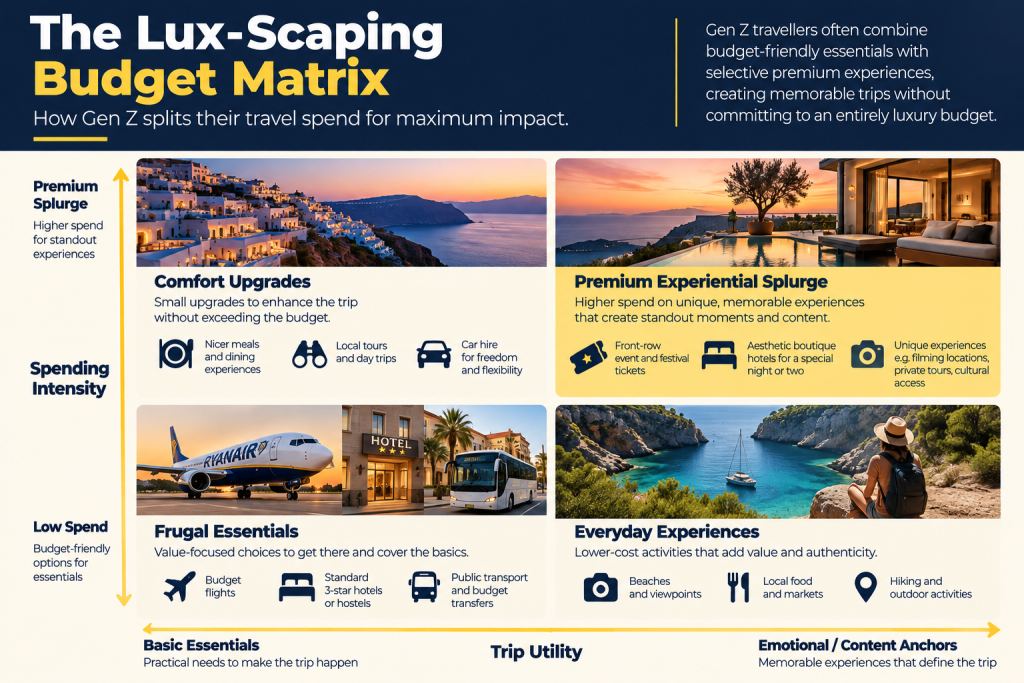
This psychological shift has given rise to a fascinating spending behaviour known across the industry as “lux-scaping”. Rather than booking a uniform, mid-tier package holiday where every night looks the same, Gen Z travellers deliberately split their budgets into extreme contrasts.
They are perfectly content to fly on an ultra-low-cost carrier with nothing but a backpack, catch a budget coach, and stay in a basic three-star property or a social hostel for four nights of a trip, saving every penny possible.
Then, on the final night, they will willingly drop £400 to book a single evening at a highly aesthetic, premium boutique hotel.
They are not doing this because they have confused budgets; they are doing it strategically to curate their experiences and their digital footprints. That single night of premium accommodation provides the high-end design, the viral content background, and the memorable climax to their holiday. The other four nights were simply utilities to get them there.
Statistical tracking from European tourism boards reinforces this split reality. Roughly 38% of Gen Z consistently operate within a per-trip spending window of £420 to £840 for standard short-haul European holidays.
Accommodation within that baseline eats up a modest 35% of the total cost. The remaining 65% of their capital bypasses the hotel room entirely, flowing directly into local experiences, independent dining, unique excursions, and event tickets.
If your hospitality brand only offers standard, middle-of-the-road room packages without integrated local experiences, you are completely invisible to this mindset. You are too expensive to compete with their budget baseline, and you are not unique or visually compelling enough to trigger their premium “lux-scaping” splurge.
By integrating your offerings directly into the ecosystem of social commerce in travel, you can capture this spontaneous, experience-led spending at the exact moment it occurs.
The Experiential Anchors Driving Travel Social Commerce
To successfully target campaigns around social commerce in travel, operators must understand what actually triggers a Gen Z booking. Older generations usually start their travel planning with a geographic location or a specific climate in mind. Gen Z operates in reverse.
They start with an experiential anchor, and the destination simply follows. This behavioural shift is precisely why traditional booking channels fail and why modern travel social commerce architectures have become essential.
The Rise of “Gig-Tripping”
Music tourism has evolved from a niche subculture into a dominant force in international travel. One in three Gen Z travellers state they will now book an international flight specifically to attend a live concert, festival, or multi-day music event. They treat the event ticket as the absolute anchor of their itinerary.
Once that ticket is secured inside a social platform or digital community, the rest of their travel ecosystem is constructed around it. When an artist announces a European tour, younger fans quickly evaluate which city offers the best value for flights and accommodation, turning a single concert into a four-day international city break. Capturing this hyper-specific intent is a primary goal for brands implementing social commerce in travel.
The “Set-Jetting” Phenomenon
Entertainment tourism is the second massive experiential driver transforming modern booking paths. Four in five UK Gen Z and Millennial travellers admit that their holiday choices are now directly influenced by locations featured in television shows, films, or viral streaming content.
Whether it is a sudden spike in regional UK travel interest in historic estates featured in streaming dramas, or a surge in boutique bookings in Sicily driven by viral television series, the screen has completely replaced the traditional travel brochure.
This visual inspiration creates an immediate, highly emotional intent to purchase. If an operator cannot capitalise on that intent through native travel social commerce tools the exact second it peaks on screen, the commercial opportunity evaporates.
Sports and Event Tourism
Major international sporting tournaments represent the third major pillar of high-cost experiential spending. Nearly half of Gen Z consumers actively plan holidays around major sporting events. When this demographic travels for sports, their average trip expenditure surges significantly, often scaling up to thousands of pounds per itinerary when multi-destination transit and premium match packages are involved.
The common thread binding all three of these experiential anchors is that they do not originate on a travel search engine. Nobody opens Google or Expedia to find inspiration for a music festival they do not know exists.
The inspiration happens natively inside algorithmically driven social feeds, through short-form video content, influencer coverage, and peer recommendations. Therefore, forcing a user to leave those inspiration hubs to complete a booking is the ultimate point of commercial failure, highlighting why social commerce in travel is no longer optional.
Re-Evaluating Lifetime Value (LTV) Formulae in Travel Social Commerce
For decades, travel marketing success was evaluated using a very simplistic transactional metric: immediate Average Order Value (AOV) against short-term Customer Acquisition Cost (CAC). If a hotel room or a tour spot cost £150 to book and cost £30 in digital advertising to acquire, the campaign was deemed a success.
This narrow focus is exactly why many brands fail to see the value in Gen Z. Because their initial transactions are often lean, group-focused, or highly budgeted, their upfront AOV looks deeply unappealing compared to a corporate business traveller or a wealthy retiree.
However, forward-thinking travel brands are completely rewriting their financial models to focus on a thirty-year cumulative equity model, leveraging the unique viral nature of travel social commerce.
Gen Z is currently in a hyper-malleable, formative phase of consumer life. Brand loyalty is notoriously difficult and incredibly expensive to engineer once a consumer hits their late thirties or mid-forties. By that stage, buying habits are deeply locked in, lifestyle routines are established, and consumers naturally gravitate toward platforms they have used for a decade.
Gen Z, by contrast, is actively deciding right now which platforms, hotel groups, and booking interfaces they prefer. If a tour operator or hospitality brand can win their trust today by delivering a flawless, friction-free digital experience, they stand to capture decades of future travel spending as that consumer moves into their peak earning years.
Deploying social commerce in travel ensures that your brand becomes their default booking habit from day one.
Furthermore, traditional LTV calculations completely ignore the peer-to-peer referral multiplier effect, which is a core characteristic of Gen Z consumer behaviour. Older generations might talk to two or three friends about a great hotel experience. Gen Z communicates at scale.
A single positive, seamless experience often results in user-generated content on TikTok, Instagram, or community channels that reaches thousands of highly targeted peers within hours.
When a Gen Z customer advocates for your brand online, they are actively driving down your organic customer acquisition cost across their entire social circle. Their true lifetime value to your business is not just the sum of their individual bookings; it is the total volume of community revenue they influence over a lifetime, a phenomenon supercharged by modern travel social commerce networks.
Designing the Ultimate Tech Stack for Social Commerce in Travel
This brings us to the core technical challenge and the single greatest opportunity for modern travel brands: the flawless execution of social commerce in travel.
Gen Z has grown up in an era of absolute digital convenience. They are accustomed to on-demand ride-sharing, instant food delivery, and one-click retail purchases. Their tolerance for digital friction is essentially zero.
Industry research shows that if a mobile application or a website booking funnel fails to load within a few seconds, or requires excessive form fields, younger users will abandon the process entirely. They will not struggle through a poorly designed user interface; they will simply assume your product is broken and never return.
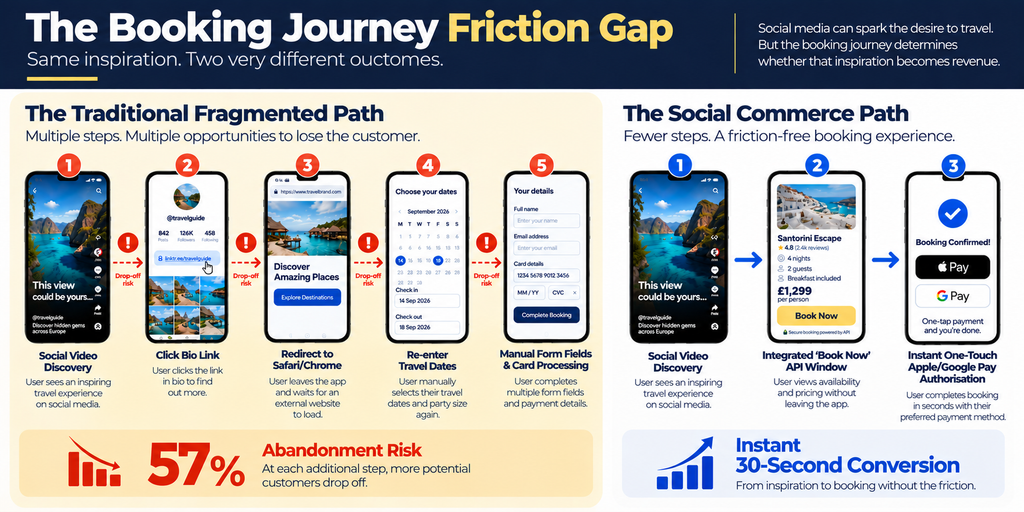
Yet, the traditional travel booking journey remains incredibly fragmented. A typical path looks like this: a user discovers an incredible, visually stunning boutique hotel while scrolling through their Instagram or TikTok feed.
They are highly inspired and want to book. However, to do so, they must click a link in a profile, get redirected to an external mobile browser, manually re-enter their desired travel dates, navigate a non-optimised mobile layout, select a room, and then manually type out sixteen digits of a credit card number while sitting on a train or a bus.
This clunky, multi-step process is the exact opposite of what a modern travel social commerce solution offers. Every single one of those steps is an exit point where conversion drops off a cliff.
This structural friction is exactly why integrated booking application programming interfaces (APIs) are becoming the ultimate competitive advantage for forward-thinking travel brands looking to master social commerce in travel.
By embedding real-time inventory, live pricing, and native secure payment processing directly inside social media environments, you allow the consumer to complete their reservation without ever leaving the host application.
From a technical perspective, succeeding with travel social commerce requires a complete overhaul of traditional property management systems (PMS) and global distribution system (GDS) architectures.
Modern travel brands must invest in robust, open API systems that can push real-time availability updates across multiple social networks simultaneously, preventing the catastrophic risk of overbooking.
When a social commerce in travel integration is executed correctly, the booking process becomes completely natural. A user watches a short-form video of a unique tour or a boutique hotel property, clicks a native “Book Now” overlay, selects their dates via an integrated calendar, and authorises the payment securely via Apple Pay or Google Pay in a single touch.
The transaction is completed in under thirty seconds, at the exact moment of peak emotional intent.
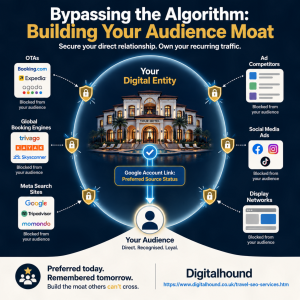
By deploying this specific technology, travel brands achieve two critical commercial goals. First, they drive immediate conversion rates up significantly, capturing impulsive, experience-led revenue that would otherwise be lost to digital distraction. Second, they bypass traditional third-party online travel agencies (OTAs) that charge massive, double-digit commission fees, allowing operators to protect their profit margins while establishing a direct relationship through their own travel social commerce ecosystem.
Conclusion: The Long-Term Play for Operators
The travel operators and hospitality brands that win the next few decades will be the ones that stop looking at Gen Z as a short-term, budget-conscious headache and start treating them as a premium lifetime asset.
Every macroeconomic indicator proves that travel is a non-negotiable priority for this generation. They will actively compromise on daily material luxuries before they ever dream of giving up their holidays.
By investing heavily in the right infrastructure, designing experience-led offerings, and removing every single point of digital friction from the booking path using social commerce in travel, you are not just securing an immediate reservation. You are securing a customer for the next thirty years.


Digitalhound's work spans technical SEO, AI-assisted content strategy, conversion optimisation and brand authority. The agency's content has achieved first page Google rankings against globally recognised publishers including Search Engine Land, TripAdvisor and Saga Holidays.
Darryl is a sought-after speaker at digital marketing conferences and has worked with clients ranging from independent law firms to FTSE-listed businesses. He writes on the intersection of AI, search strategy and commercial communication.
Digitalhound | 207 Regent Street, London W1B 3HH | digitalhound.co.uk | content@digitalhound.co.uk | 020 7873 2476