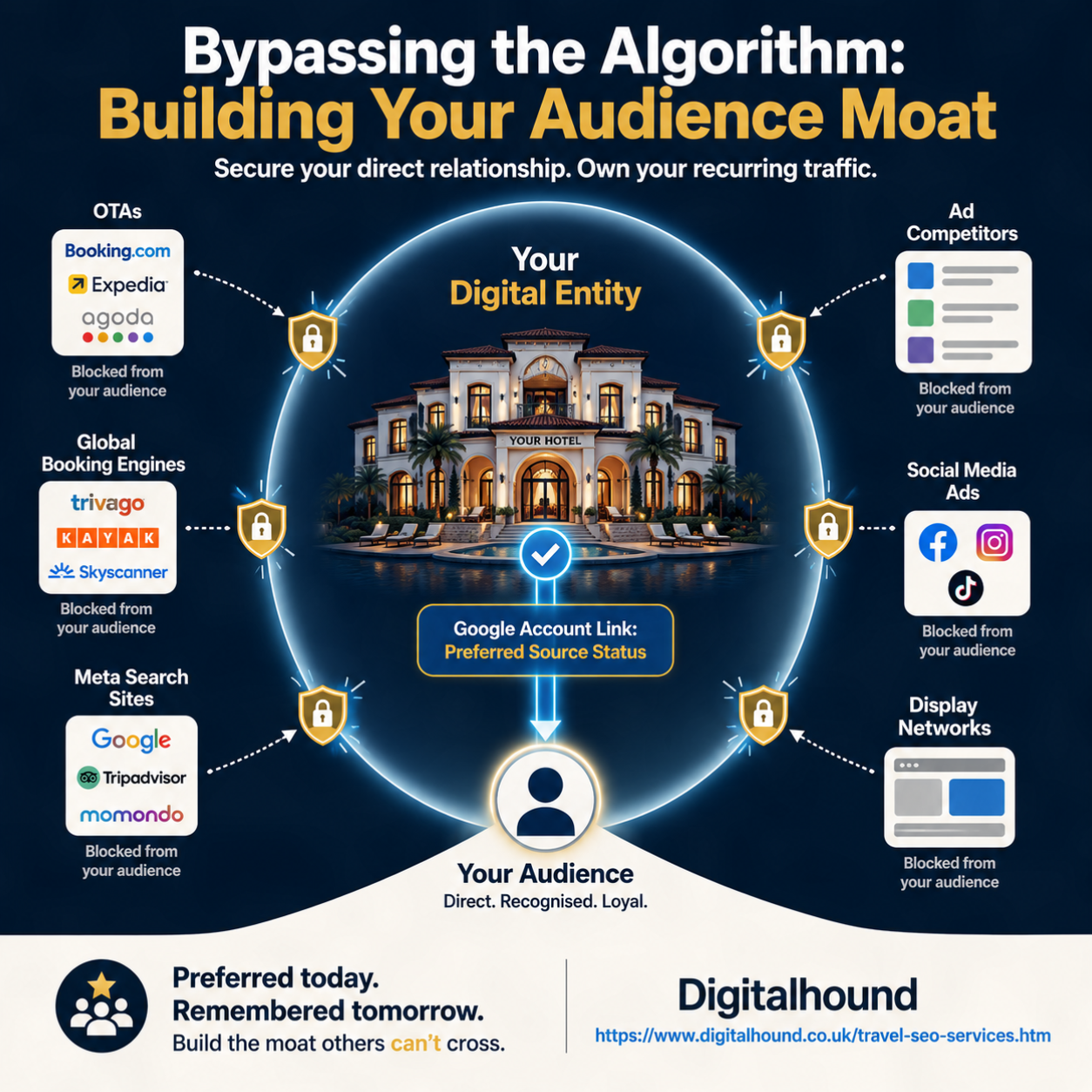
Travel SEO has become an absolute necessity for businesses looking to survive the shift toward AI-driven search. As AI Overviews increasingly answer conversational holiday queries directly on the search page, traditional keyword tactics are failing. Modern travel seo focuses heavily on building an audience moat through Google’s Audience Loyalty Ecosystem. By encouraging holidaymakers to save your domain as a Preferred Source, you secure a permanent, highly targeted traffic pipeline that bypasses standard algorithmic changes and competitor rankings entirely.
Table of Contents
The Death of the Organic Click: Why Travel SEO Demands a Radical Paradigm Shift
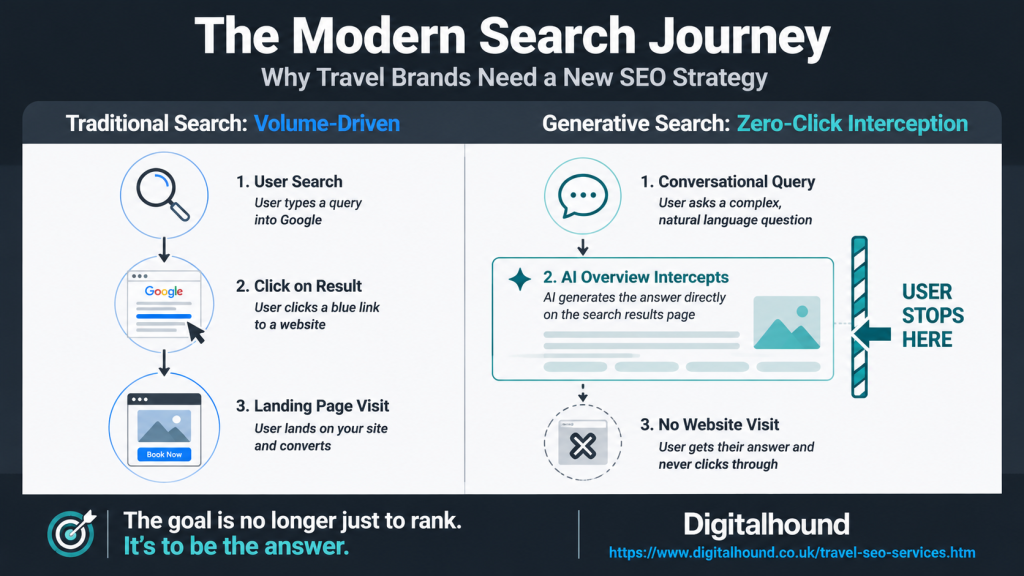
For over two decades, the travel sector operated on a predictable and highly lucrative digital compact. A consumer dreamed of a holiday, typed a query into Google, and clicked a blue link. From that moment, the travel brand took ownership of the relationship, guiding the user down a carefully constructed booking funnel. Success was a pure volume game, measured in keyword rankings and click-through rates.
That era is officially over.
The rapid proliferation of AI Overviews, generative search experiences, and Google’s own aggregated travel modules have fundamentally altered consumer behaviour. We have entered the age of the zero-click search, where the traditional organic funnel is intercepted directly on the search engine results page (SERP). For travel brands, from boutique luxury hotels to multinational tour operators, this is not merely a technical update to a legacy algorithm. It is a profound, structural evolution that reshapes how we approach travel seo.
To survive this shift, the industry must undergo a radical psychological pivot: we must transition from volume-based search acquisition to relationship-based ecosystem retention.
The Capture of Intent
Travel is inherently research-intensive. Historically, this complexity worked in favour of the travel marketer. A user planning an intricate multi-city itinerary through Italy would generate dozens of search touches, visiting blogs, forums, and operator sites.
Today, Google’s AI models effortlessly synthesize those fragmented subtopics. A single conversational prompt now yields a comprehensive, beautifully structured itinerary complete with flight options, real-time hotel availability, and local restaurant recommendations, all without the user ever clicking out to the open web.
The harsh reality for the travel sector per se is brutal: if your content can be easily summarised by an AI, it will be. Chasing generic search volume for standard destination guides is now a textbook exercise in diminishing returns. Google is no longer a mere concierge pointing users toward your digital doorstep; Google has become the destination itself.
The New Currency: The Audience Moat
When Google controls the top of the funnel entirely, traditional search engine optimisation becomes defensive at best. The forward-thinking travel marketer must look deeper into Google’s newly unveiled architecture, specifically, the Audience Loyalty Ecosystem.
Google’s strategic objective is clear: keep users securely inside its own ecosystem. However, to maintain user trust, its AI requires highly accurate, authoritative data sources. To incentivise brands to feed this machine, Google has quietly introduced a revolutionary mechanism that rewards true brand equity, transforming the foundational rules of travel seo.
This ecosystem relies heavily on user-driven personalisation, most notably through features like Preferred Sources. If a travel brand can cultivate genuine, deep-seated loyalty, it can compel its audience to explicitly save its domain as a trusted entity within their Google settings.
The ramifications of this change are game-changing for travel SEO:
- Algorithmic Disintermediation: When a loyal holidaymaker marks your brand as a Preferred Source, standard global rankings are overridden for that individual.
- The Permanent Pipeline: Future conversational queries made by that user will automatically prioritise and highlight your content inside their AI Overviews, complete with a prominent Preferred badge.
The Loyalty Moat: You are no longer competing globally against massive aggregate sites or multi-million-pound ad spend for that user’s attention. You have built a private digital moat.
Moving From Keywords to Entities
This structural evolution forces travel brands to stop thinking in terms of transient keywords and start thinking in terms of entities and relationships.
In this new paradigm, true travel seo is about proving to Google’s AI that your brand possesses the actual, real-world expertise required to validate its summaries, while simultaneously activating your existing audience to signal their preference directly to the algorithm.
It is a double-pronged strategy: optimising your digital architecture for machine synthesis, and maximsing your human relationships for direct account-level opt-ins.
The brands that will thrive in this next era of the internet are not those trying to outsmart a global algorithm with artificial keyword density. The victors will be the travel leaders who successfully transform casual, passive web traffic into an active, locked-in digital asset.

The Practical Roadmap: Navigating the Technical Architecture of Modern Travel SEO
Transitioning from a legacy keyword strategy to an ecosystem-retention model requires immediate, structural action. To counteract zero-click interception, travel brands must execute a precise technical playbook designed to satisfy Google’s AI data-scraping models while securing direct user commitment.
Below is the definitive, step-by-step framework to adapt your digital infrastructure for this new era of travel seo.
Step 1: Claim and Centralise Your Digital Entity
Before you can build an audience moat, Google’s AI must recognize your brand as a singular, authoritative entity rather than a disconnected collection of landing pages. Larger online travel agencies (OTAs) naturally hold vast data footprints, meaning smaller operators and boutique hotels must be far more disciplined with their structural architecture to compete.
[Fragmented Subdomains] ➔ Disqualifies AI Scraping ➔ Lost Visibility
[Centralised Root Domain] ➔ Powers Semantic Synthesis ➔ AI Overview Citation
- The Action: Centralise all digital assets under a single root domain.
- The Implementation: If your travel blog, booking engine, or regional micro-sites sit on fragmented subdomains (e.g. ://yourbrand.com), migrate them immediately into subdirectories (e.g. ://yourbrand.com).
- The Comparison: Much like a hotel group benefits from having its concierge, reception, and amenities under one physical roof, your website must centralise its data. Fragmented subdomains dilute your semantic authority, making it highly difficult for Google to map your true expertise.
Step 2: Embed Frictionless Loyalty Loops
Because a user selecting you as a Preferred Source relies entirely on a deliberate, one-time setup action, you cannot leave this to chance. A luxury villa company cannot expect a guest to navigate deep into their Google Account privacy menus. You must bring the shortcut directly into their user journey to maximize the value of your travel seo campaign.
- The Action: Deploy direct, clickable deep-link buttons across high-intent touchpoints.
- The Implementation: Embed a bespoke “Save as Preferred Source on Google” button into post-booking confirmation pages, monthly itineraries, and newsletter footers. Use the dedicated URL template: https://google.com.
- The Comparison: Think of this as the digital equivalent of a loyalty card. Just as an airline prompts a flyer to join their frequent flyer programme immediately after purchasing a ticket, a digital travel marketer must prompt a user to lock in their search preference the moment their brand satisfaction is at its highest.
Step 3: Pivot Content Architecture to First-Hand Expertise
Google’s generative AI can effortlessly write a generic guide on the top sights in Paris because the open web is flooded with that exact data. If your travel guides read like an aggregation of text, the AI will scrape it, summarise it, and display it on the search page without giving you a single click. You must produce content that is impossible for a machine to replicate.
- The Action: Overhaul your content briefs to enforce proprietary data and human perspective.
- The Execution: Stop publishing generic top ten lists. Instead, publish proprietary booking data trends, exclusive video interviews with local ground experts, and original high-resolution photography with unique descriptive metadata.
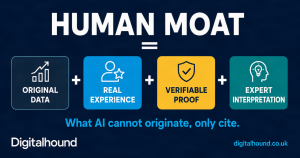
- The Comparison: Consider the difference between a high-street guidebook and a personal consultation with a specialist private guide. The machine can copy the guidebook, but it cannot forge the live, real-time insights of the specialist. Write explicitly in the first person, such as “Our team personally vetted these five boutique properties in May”, which signals human experience directly to the AI text scraper.
Step 4: Structuring for Machine Readability
Winning a position inside Google’s AI Overview boxes for non-preferred users requires your data to be perfectly organised. The AI prefers data that can be ingested instantly without rendering complex layouts.
Unstructured Paragraphs ➔ Hard for AI to Quantify ➔ Low Snippet Eligibility
Structured Data Tables ➔ Instantly Ingested by AI ➔ High Overview Citation
- The Action: Introduce explicit semantic formatting and “Obvious Answer” introduction blocks.
- The Execution: Open every travel article with a highly direct, bolded summary answering the core prompt in 50 words or less. Furthermore, convert dense paragraphs of destination prices, seasonal weather, or flight durations into clean HTML data tables (<table>) and structured lists (<ul>).
- The Comparison: Imagine an immigration officer reviewing a disembarkation card versus a chaotic stack of unorganised papers. The clean, structured card gets processed instantly. By structuring data cleanly, you allow the AI scraper to lift your tables and lists directly into the search results page with a prominent citation link to your domain.
Step 5: Isolate and Audit Your AI Visibility
Traditional rank tracking tools are fundamentally blind to how your site behaves within an AI summary layer. To outmanoeuvre niche competitors, you must measure where you are actively being displayed versus where you are losing the citation.
Traditional SEO Tracking ➔ Tracks Global Ranks ➔ Blind to AI Interception
Modern AI Performance ➔ Tracks Conversational Prompts ➔ Captures True Visibility
- The Action: Isolate your AI performance metrics using Google Search Console (GSC).
- The Execution: Utilise the Generative AI performance reports in GSC. If the update hasn’t hit your profile yet, apply a Search Appearance: AI Overviews filter to your standard results. Focus heavily on conversational, long-tail queries where your impressions are high but your click-through rate is low.
- The Comparison: This is identical to checking your booking abandonment rates. If thousands of people see your flight itinerary summary inside an AI card but no one clicks through to your website, your content is missing the vital piece of expert text that forces a user to click for the full story. Use these insights to identify exactly which competitor domains are winning the citation box for those phrases, audit their page structure, and adjust your layout to claim the spot.

Phase 3: The Democratisation of Travel Search and Your Next Steps
The emergence of Google’s Audience Loyalty Ecosystem marks a profound shift in the balance of power within online travel marketing.
For years, the digital travel landscape has been dominated by massive online travel agencies (OTAs) and global booking aggregators wielding multi-million-pound ad budgets and vast teams of search engine optimisation (SEO) professionals.
In a pure volume game, independent operators and boutique brands simply could not compete for the highest-traffic keywords.
AI-driven search completely flips this dynamic on its head.
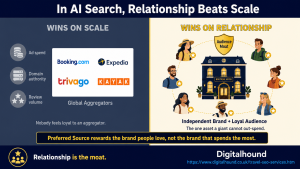
Because features like Preferred Sources are powered by individual user choice rather than global algorithmic clout, a highly specialised local tour operator or a boutique luxury hotel can establish an identical level of search dominance as a global conglomerate, for their specific audience.
If a holidaymaker actively trusts your brand and locks you in as their preferred source, Google’s AI customises their search experience to prioritise your insights, effectively cutting out the middleman.
This new ecosystem rewards genuine relationship equity over raw marketing spend. It levels the digital playing field, ensuring that the travel brands which cultivate deep, authentic connections with their clients can protect their traffic, reduce their long-term acquisition costs, and bypass the zero-click squeeze entirely.
Implementing a modern blueprint for travel seo is no longer optional, it is the only way to safeguard your brand’s digital future.
The Modern Travel SEO Quick-Start Checklist
Use this practical, high-level checklist to audit your digital infrastructure and ensure your travel brand is prepared to thrive in the era of generative AI search.
1. Technical Domain Setup
- Eliminate Subdomains: Ensure your travel blog or booking engine is housed within a main subdirectory (e.g.
://yourbrand.com) rather than on a disconnected subdomain. - Validate Core Web Vitals: Confirm your website loads quickly and efficiently on mobile devices, as Google’s AI models prioritise highly responsive domains for live search summaries.
- Review Schema Mark-up: Implement flawless publisher and article structured data code across your site to clearly identify your brand as an established digital entity.
2. Loyalty Loop Integration
- Deploy Deep Links: Insert custom Preferred Source buttons (
https://google.com) across your most satisfied digital touchpoints. - Optimise Transaction Footers: Place a direct call-to-action (CTA) on your booking confirmation pages prompting guests to save your brand to their Google Account.
- Prepare Newsletter Integration: Design a dedicated segment for your upcoming email newsletters to guide new subscribers through the quick, one-click opt-in process.
3. Content Architecture Refinement
- Embed “Obvious Answers”: Revise the introductory paragraphs of your high-priority blog posts to lead with a direct, 50-word bolded summary of the core user query.
- Convert Data to Clean HTML: Audit dense blocks of text containing flight durations, package prices, or hotel amenities, and convert them into structured HTML tables (
<table>) or bulleted lists (<ul>). - Enforce First-Hand Perspective: Rewrite generic destination insights to explicitly showcase real human experience, utilizing first-person language and proprietary internal data.
4. Performance Monitoring
- Isolate GSC AI Telemetry: Check your Google Search Console profile regularly for the new Generative AI performance dashboard, or apply the Search Appearance filter to track your AI Overview impressions.
- Analyze Low-Click Queries: Identify the conversational, long-tail phrases where your site has high visibility but low click-through rates, indicating that an AI card is intercepting your traffic.
- Execute Competitor Audits: Search those low-clicking queries in a clean browser window to discover which competing domains are winning the AI citation, and adjust your content layout to match their structural strengths.
Scaling Your Post-Click Strategy
Implementing a modern ecosystem blueprint is a structural challenge that goes beyond standard search optimisation.
If your brand requires specialised support to map out these entity relationships, implement frictionless loyalty loops, and restructure complex content for machine synthesis, our team is equipped to guide your transition.
Explore our comprehensive Travel SEO Services to learn how we build impenetrable digital moats for forward-thinking travel brands.
★ Enjoyed this guide? Make Digitalhound one of your Preferred Sources on Google.


Digitalhound's work spans technical SEO, AI-assisted content strategy, conversion optimisation and brand authority. The agency's content has achieved first page Google rankings against globally recognised publishers including Search Engine Land, TripAdvisor and Saga Holidays.
Darryl is a sought-after speaker at digital marketing conferences and has worked with clients ranging from independent law firms to FTSE-listed businesses. He writes on the intersection of AI, search strategy and commercial communication.
Digitalhound | 207 Regent Street, London W1B 3HH | digitalhound.co.uk | content@digitalhound.co.uk | 020 7873 2476


Seeing this play out in our own data. The travel brands building direct audience relationships are holding their visibility even as zero-click searches increase. The ones relying purely on keyword rankings are feeling the squeeze. Preferred Source is the mechanism that explains why the gap is widening.
That widening gap is the clearest commercial signal that the shift is real John. The brands investing in audience relationships now are building something measurable. The ones waiting are falling further behind with each passing month.