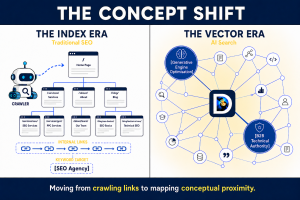
A Strategic Briefing for Law Firm Chief Marketing Officers | Published by Digitalhound

Table of Contents
Executive Summary: The Paradox of Modern Legal SEO
Many Chief Marketing Officers across the UK legal sector are reviewing their digital marketing dashboards and noticing a perplexing mismatch. Monthly reports from external SEO suppliers highlight completely stable organic keyword rankings and rising total impression metrics.
Yet, when cross-referenced with internal case management software, the actual pipeline of inbound phone calls, form completions, and high-value instructions is hitting a visible wall.
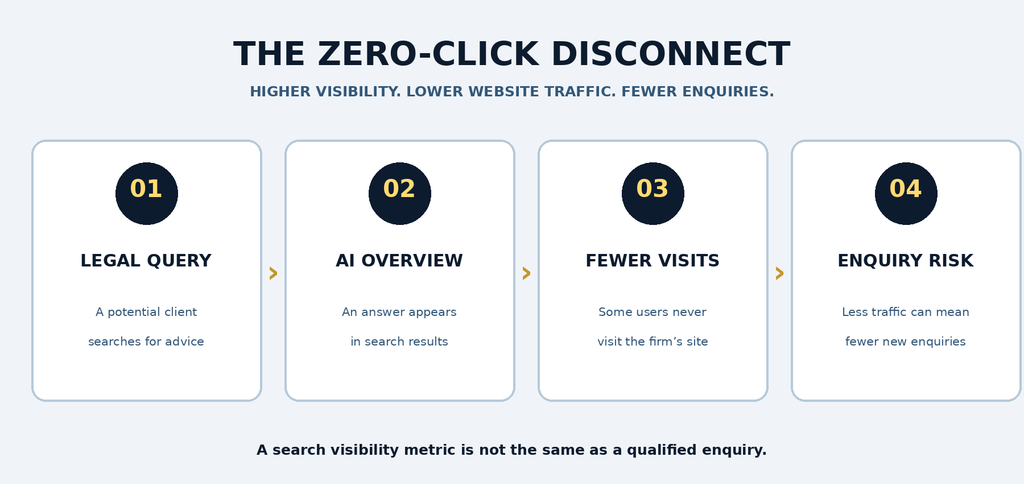
This commercial disconnect is driven by a profound and sudden transformation in search engine architecture. The rapid rollout of Google AI Overviews combined with a sharp global increase in zero-click search journeys has completely bypassed the traditional web traffic model.
For years, the established legal marketing strategy was straightforward: publish high volumes of educational blog posts to capture top-of-funnel traffic, then nurture those users into paying clients.
In the modern search environment, this high-volume approach has transformed into a severe commercial vulnerability known as ‘AI content debt’.
This document outlines the technical mechanisms behind this disruption, provides verified UK industry benchmarks, examines the compounding compliance liabilities under the Solicitors Regulation Authority, and outlines the precise framework required to insulate and modernise your firm’s digital acquisition pipeline.
For law firm CMOs, understanding AI Content Debt For Law Firms is therefore a commercial priority, not simply a technical SEO concern..
1. The Metrics of the Zero-Click Reality
The traditional marketing model relies entirely on a user leaving a search results page to read an answer on a law firm’s domain. Modern search systems have systematically eliminated this step for broad informational queries.
Recent data reveals that the classic organic search funnel is no longer functioning as an open pipeline:
| Search Query Classification | UK Baseline Metric | Direct Commercial Impact on Law Firms |
|---|---|---|
| Informational & Advice Search | AI Overviews now trigger on 54.3% of all UK legal queries. | Click-through rates to organic website listings fall by up to 64% as answers are consumed on the results page. |
| Zero-Click Search Volatility | UK records the highest rate of zero-click journeys globally at 69.5%. | Firms fund the creation of baseline educational text that Google scrapes to answer user questions, delivering zero web traffic. |
| Overall Digital Visibility | Independent testing across 18 UK law firms recorded a 42% median drop in search impressions. | Firms maintain nominal top organic keyword rankings but experience a quiet collapse in actual inbound traffic volume. |
The data outlines a clear structural divide based on user intent. On pure advice queries (such as ‘how to write a will’ or ‘grounds for a commercial lease dispute’), AI platforms present the user with a highly structured summary compiled directly from scraped web content.

Because the user obtains a complete legal summary instantly, the incentive to click through to an external blog post disappears entirely. The firm absorbs the financial cost of producing the content, while Google captures the user retention.
2. Understanding the Mechanics of ‘The AI Content Debt For Law Firms’
The widespread nature of this issue inside mid-market and Top 200 UK law firms stems from a resource mismatch. The typical internal legal marketing department remains structurally lean, frequently consisting of an overextended team of two or three specialists focused on brand alignment, directory submissions, and partner relations.
To maintain visibility, up to 60% of UK firms outsource core search engine execution to external digital marketing suppliers, running monthly retainers typically averaging between £1,500 and £4,000+.
To hit aggressive monthly volume quotas profitably, many legacy agencies quietly integrated generative AI writing assistants into their workflows. Over the last twenty-four months, this resulted in an unprecedented flood of rehashed, boilerplate content across firm blogs. While this strategy successfully inflated keyword profiles initially, modern core algorithms treat this volume of unoriginal text as an architectural risk.
This is how AI Content Debt For Law Firms accumulates: publishing activity increases while the distinct value of the content diminishes.
Search infrastructure has pivoted sharply toward a concept known as Information Gain. Modern algorithms are explicitly designed to scan a domain and evaluate whether an article introduces non-obvious facts, verified first-party data, or unique expert analysis that does not exist elsewhere on the web.
If a firm’s blog library is bloated with generic explanations of statutes or standard legal checklists, the system views the domain as a low-effort content clearinghouse, systematically reducing its authority across all practice areas. Google’s spam policies
3. The Compounding SRA Compliance Exposure
For a law firm CMO, the AI content debt for law firms is not merely a technical search engine penalty; it represents an immediate and documented regulatory risk. The Solicitors Regulation Authority (SRA) has significantly tightened its focus on digital communication and automated transparency.
SRA data shows that misconduct reports handled by their assessment teams remained at historically high volumes in early 2026, averaging nearly 1,500 individual cases reviewed per month.
Under SRA Code of Conduct Rule 8.6, law firms maintain absolute, non-delegable liability for the accuracy, clarity, and compliance of all advertising and public-facing marketing material. The regulator explicitly rejects the defense that an external digital agency or an automated software tool acted without direct human oversight.
| Marketing Operation | Algorithmic & Procedural Status | SRA Regulatory Risk Vector |
|---|---|---|
| Automated Content Feeds | Agencies utilising generative AI to publish broad weekly blog updates. | Breach of transparency and accuracy guidelines if automated text overstates case legalities or delivers out-of-date legal statistics. |
| Dynamic Advertising Text | Google Ads ‘auto-apply recommendations’ generating automated headline variants. | Misleading marketing claims under Rule 8.6 if automated testing combinations match practice areas or fee metrics inaccurately. |
| Legacy Informational Libraries | Unreviewed historical advice guides sitting unchecked on old firm domains. | Failure to provide clear, current regulatory disclosures, misleading potential clients regarding active UK legislation. |
The automation of legal text removes the human-vetted quality control that safeguards professional integrity. When an agency pushes live an unverified article containing subtle legal inaccuracies or outdated statutory references, the firm faces immediate exposure.
CMOs must transition to a workflow where every single piece of published text is tied directly to a qualified human author. Addressing AI Content Debt For Law Firms consequently requires editorial oversight as well as technical remediation.
4. The Strategic Pivot: Generative Engine Optimisation (GEO)
The correction for this exposure is not to completely abandon digital visibility efforts, but to fundamentally alter the underlying framework. Sophisticated legal marketers are actively moving away from traditional keyword-centric optimisation and transitioning into Generative Engine Optimisation (GEO). For a closer look at this transition, explore Digitalhound’s guide to AI search visibility for law firms.
The goal of GEO is to ensure that when a corporate client or high-value individual asks a conversational question inside platforms like OpenAI’s ChatGPT, Perplexity, or Google AI Overviews, your firm is selected as the trusted, cited authority.
Research tracks a 35% increase in high-intent organic clicks and a 91% surge in targeted client engagement for firms that successfully capture these direct conversational citations compared to those omitted from the AI summary loop. Tackling AI Content Debt For Law Firms is an essential part of making that transition sustainable.
To transition your firm’s current digital footprint from an algorithmic liability into a modern conversion engine, Digitalhound recommends a four-stage execution roadmap:
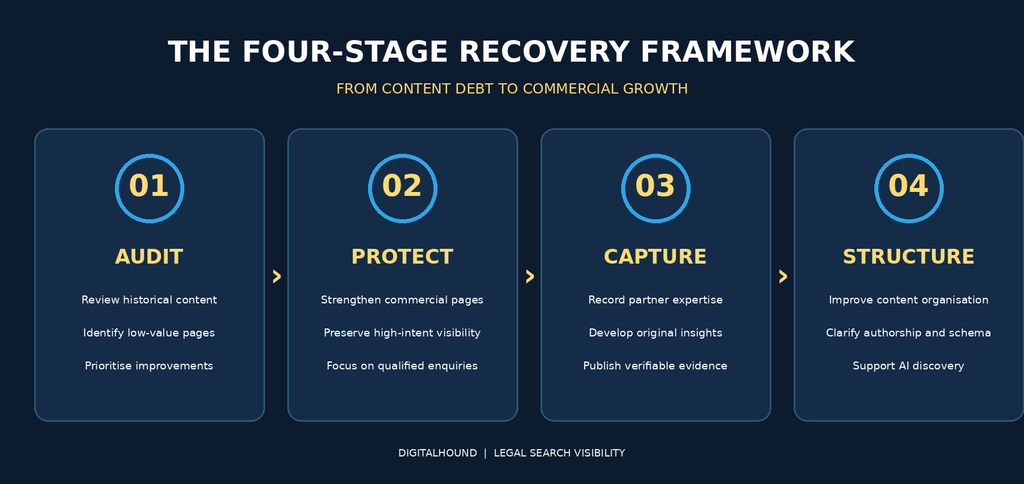
- Stage 1: The Content Debt Inventory — Systematically audit all historical blog posts published over the past thirty-six months. Identify and aggressively prune low-performing, low-information text that mimics standard AI rehashes, instantly reducing your site’s overall algorithmic risk.
- Stage 2: Insulate the Commercial Perimeter — Re-optimise localized commercial landing pages (such as regional practice area headers) that target high-intent transactions. These queries remain highly defensible, routing users directly into local map interfaces and local organic listings.
- Stage 3: Institutionalise Partner Knowledge Capture — Deconstruct the content approval bottleneck. Replace the expectation for busy partners to draft long articles with brief, ten-minute recorded debriefs immediately following a major transaction or litigation success. Convert these raw, unreplicable human insights into high-information-gain data assets.
- Stage 4: Structural GEO Formatting — Configure your website’s schema architecture and data formatting so modern AI discovery engines can seamlessly parse, ingest, and explicitly cite your firm’s expert insights as primary source material.
Conclusion: Auditing Your Current Exposure
The traditional legal marketing playbook is currently undergoing its most significant structural shift in a generation. Continuing to fund high-volume, generic blog networks does not merely represent a waste of marketing resources; it systematically actively reduces your search engine visibility while quietly generating unmonitored regulatory risk.
Before signing off on your upcoming external agency retainers, it is vital to establish an objective, independent assessment of your firm’s true digital footprint.
CMOs must determine exactly how much of their baseline traffic is being actively swallowed by zero-click interfaces and verify if their current content strategy satisfies modern Information Gain criteria.
An assessment of AI Content Debt For Law Firms should therefore consider both the quality of existing content and its contribution to genuine client enquiries.
The Digitalhound team provides specialised, technical risk assessments for mid-market and Top 200 UK law firms, mapping zero-click exposure and compliance vectors without requiring direct access to your internal IT environments.
To coordinate a confidential baseline review for your firm’s domain, connect with our consulting team directly via LinkedIn or our official channels to schedule an initial benchmark review.


Digitalhound's work spans technical SEO, AI-assisted content strategy, conversion optimisation and brand authority. The agency's content has achieved first page Google rankings against globally recognised publishers including Search Engine Land, TripAdvisor and Saga Holidays.
Darryl is a sought-after speaker at digital marketing conferences and has worked with clients ranging from independent law firms to FTSE-listed businesses. He writes on the intersection of AI, search strategy and commercial communication.
Digitalhound | 207 Regent Street, London W1B 3HH | digitalhound.co.uk | content@digitalhound.co.uk | 020 7873 2476